
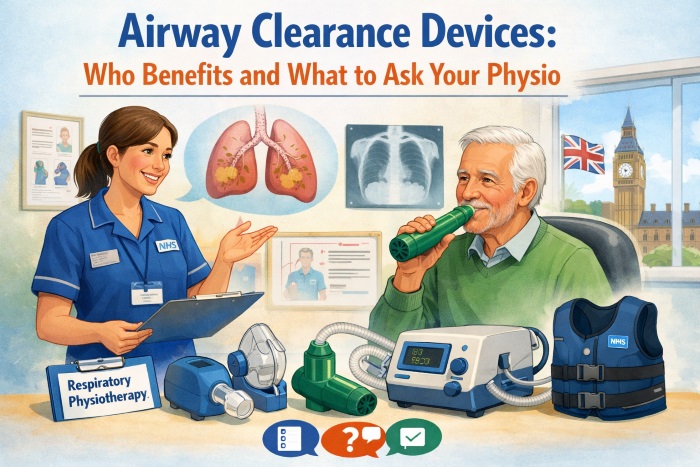
Airway clearance devices can help you shift sticky mucus when your lungs struggle to clear it on their own. Used well, they can reduce chest mucus, ease breathlessness linked to congestion, and help you cough more effectively, but only if the device matches your condition, your breathing pattern, and your daily life.
What are airway clearance devices?
Airway clearance sits within chest physiotherapy. It includes breathing techniques (like the Active Cycle of Breathing Technique, or ACBT) and equipment that supports those techniques. Many devices work by creating resistance as you breathe out. That back-pressure can help keep smaller airways open and move air behind mucus so it can travel up and out. Some devices add vibrations (oscillations) to loosen secretions.
Airway clearance devices do not “cure” the cause of mucus. They support the mechanics of getting mucus out, which matters because trapped mucus can fuel infection, inflammation, and flare-ups in several long-term lung conditions.
Who might benefit from airway clearance devices?
Your respiratory physician and chest physiotherapist will guide you to using these devices if they are felt to be helpful for your condition. As a rule, devices help most when you produce regular sputum (phlegm), you get recurrent chest infections, or you cannot cough strongly enough to clear secretions.
People who commonly benefit include those with:
1) Bronchiectasis
Bronchiectasis often brings daily or frequent sputum and recurrent infections. UK guidance for bronchiectasis emphasises that people should learn airway clearance techniques from a respiratory physiotherapist and have them reviewed after diagnosis and at follow-up. If you are seeing a physician who understands bronchiectasis they will put you in touch with an expert chest physiotherapist that understands bronchiectasis.
2) Cystic fibrosis
Airway clearance forms a core part of cystic fibrosis care, and many people use devices such as PEP or oscillating PEP alongside breathing techniques.
3) COPD with chronic bronchitis-type symptoms (regular sputum)
Some people with COPD produce mucus most days. A physio may trial a device if you struggle to clear secretions or you get frequent infective exacerbations. Evidence varies, so a personalised trial matters.
4) Neuromuscular or neurological conditions that weaken cough
If your cough is weak, mucus can sit in the airways and trigger infections and collapse of lung areas. Mechanical cough augmentation (such as mechanical insufflation–exsufflation) can help when cough flow stays low or you cannot clear secretions reliably.
Examples include motor neurone disease/ALS, muscular dystrophy, spinal muscular atrophy, and high spinal cord injury (your team will advise on your exact diagnosis and needs).
Types of airway clearance devices and what they feel like
Your physio may trial more than one option. Comfort and consistency matter as much as the theory.
Positive Expiratory Pressure (PEP) devices
PEP devices provide steady resistance on the way out. Many people use a mask or mouthpiece. You breathe in, hold briefly (sometimes), then breathe out actively but not forcefully against resistance. This can help keep airways open and move air behind mucus.
You might like PEP if you:
- prefer a steady, predictable feel
- get wheezy or “floppy” small airways that shut during exhalation
- need something simple and portable
Oscillating PEP (OPEP) devices (e.g., Flutter, Acapella-style devices)
OPEP combines resistance with vibrations during exhalation. The oscillation can reduce mucus stickiness and help move secretions.
People often choose OPEP because it:
- feels like it “shakes loose” mucus
- pairs well with huffing and coughing
- fits into a short daily routine
High-frequency chest wall oscillation (HFCWO) vests
A vest connects to a machine that rapidly inflates/deflates to vibrate the chest. Many routines pause every few minutes for huffs or coughs.
Vests can suit people who:
- need a hands-free method
- struggle to learn or perform breathing-based techniques
- need help from a carer and want a more consistent routine
Clinicians often consider HFCWO after trials of other techniques as evidence lacks to support their use above other airway clearances techniques.
Mechanical insufflation–exsufflation (MI-E) “CoughAssist”
MI-E supports a weak cough by delivering positive pressure to inflate the lungs, then quickly switching to negative pressure to simulate a cough and move secretions upward.
Services often use objective measures (such as peak cough flow) alongside clinical judgement to decide who needs MI-E, especially in neuromuscular disease.
Other options you may hear about
Some centres use intrapulmonary percussive ventilation (IPV) or adjuncts like nebulised saline, depending on diagnosis and local pathways. Your physio will steer you towards what your team can support safely and consistently.
How your physio chooses the right device
A good assessment goes beyond “what’s popular”.
Your physio may look at:
- your diagnosis and typical sputum volume (daily? flare-ups only?)
- how easily you fatigue
- your cough strength and whether you can huff effectively
- breathing pattern (do you wheeze? do you trap air?)
- reflux symptoms (some positions and techniques can worsen it)
- pain, osteoporosis risk, rib issues, or recent surgery
- coordination and hand strength (important for some hand-held devices)
- infection risk and cleaning practicality at home
What to ask your physio before you buy or commit
Bring this checklist to your appointment.
Questions about “fit”
- Which problem are we targeting: too much mucus, thick mucus, weak cough, or frequent flare-ups?
- What tells us I need a device rather than breathing techniques alone?
- Which device options suit my breathing pattern (especially if I wheeze or trap air)?
- What should it feel like when I do it correctly?
Questions about technique
- Can you watch me use it and adjust the resistance/setting?
- How long should each session last, and how many sessions per day?
- When should I huff, cough, or pause?
- Should I use postural drainage positions, or do you want me upright?
Questions about timing with medicines
- Should I use a reliever inhaler before treatment?
- If I use nebulised saline or other inhaled treatments, what order works best for me?
- On days I feel well, do I still do it? What changes during an exacerbation?
Questions about safety
- When should I stop and seek advice (for example, chest pain, dizziness, significant breathlessness, or coughing blood)?
- Are there reasons I should avoid certain pressures or positions?
- How do I manage reflux, headaches, or ear pressure during treatment?
Practical questions
- How do I clean it, dry it, and store it?
- How often do I replace parts?
- Can I travel with it?
Cleaning and infection control
Cleaning matters because these devices meet mucus and saliva. Always follow the manufacturer’s instructions and your physiotherapist’s advice.
For example, the recommendation is to clean an Acapella-type device after each use by disassembling it, washing in warm soapy water, rinsing well, and allowing parts to air-dry.
Ask your physio to show you:
- how to take it apart without damaging it
- which parts need extra attention
- whether you need periodic disinfection (and how)
Getting better results at home (without overthinking it)
- Pair the routine with something you already do (morning tea, after a shower, before evening telly or bedtime).
- Keep a “quick start” note on your phone with your steps and settings.
- Aim for effective huffs, not dramatic coughing. Technique beats force.
- Hydrate, unless your clinician has told you to restrict fluids.
When to seek urgent help
Contact your clinical team urgently (or seek emergency care) if you cough up significant amounts of blood, develop sudden sharp chest pain with breathlessness, feel faint, or notice a rapid deterioration. If you have a long-term condition, ask your physio what your personalised red flags are.
FAQs
1) Can airway clearance devices replace breathing exercises like ACBT?
Often, no. Many people get the best results by combining a device with huffs/cough and breathing control. Your physio will build a plan around your response to treatment.
2) How quickly should I notice a difference?
Some people clear mucus immediately in the first session. Others notice fewer symptoms and easier clearance over days to weeks. Track symptoms and flare-ups, then review with your physio.
3) What if a device makes me wheezy or tight-chested?
Stop, rest, and use your reliever inhaler if prescribed. Then speak to your physio. You may need a different resistance, a different technique, or a different device type.
4) Is a cough-assist device only for neuromuscular disease?
It’s most common there, but clinicians also use MI-E for people who cannot cough effectively in other settings. The key issue is cough effectiveness and secretion clearance, not a label.
GET IN TOUCH
Schedule a Visit with Dr Jose
For an assessment of your diagnosis and treatment.
Disclaimer: The information provided in this article is for informational purposes only and is not a substitute for professional medical advice, diagnosis, or treatment, and is not an advertisement for medical products. Always seek the advice of your healthcare provider with any questions you may have regarding a medical condition or treatment. Your healthcare professional can assess your individual circumstances. Consultation does not guarantee suitability for any specific treatment; all clinical decisions follow an individual assessment and shared decision-making