
Unexplained breathlessness
Testing can identify airflow, lung-volume, gas-transfer or exercise-related abnormalities.
Specialist respiratory assessment using objective tests to measure airflow, lung volumes, gas transfer, airway inflammation and exercise capacity.

Lung function tests are a group of investigations that measure how effectively the lungs move air, hold air, transfer oxygen and respond to exercise or inhaled medication.
Breathlessness, cough, wheeze and reduced exercise tolerance cannot always be explained by symptoms or chest imaging alone. Lung function testing provides objective information about how the lungs are working.
The tests required depend on the clinical question. Some patients need straightforward spirometry, while others benefit from detailed lung-volume, gas-transfer, airway-inflammation or exercise testing.
Results are interpreted alongside the medical history, examination, medication, smoking history, chest imaging and other investigations. A numerical result should not be interpreted in isolation.
A normal result on one test does not necessarily exclude respiratory disease. Different tests examine different aspects of lung function.
Testing may be used to investigate symptoms, confirm or refine a diagnosis, monitor a known respiratory condition or assess fitness before treatment, surgery or air travel.
Testing can identify airflow, lung-volume, gas-transfer or exercise-related abnormalities.
Spirometry, reversibility and FeNO may help investigate asthma and other causes of respiratory symptoms.
Serial measurements can monitor asthma, COPD, bronchiectasis, pulmonary fibrosis and other lung conditions.
Lung function, CPET or hypoxic challenge testing may contribute to planning before surgery or air travel.
Spirometry measures how much air can be exhaled and how quickly air can be breathed out following a full breath in.
You will usually sit upright and wear a nose clip. After taking a full breath in, you will seal your lips around a disposable mouthpiece and blow out as hard, fast and completely as possible.
The manoeuvre is repeated to ensure that the results are technically acceptable and reproducible.
The amount of air exhaled during the first second of a forced breath.
The total amount of air exhaled during the complete forced breathing manoeuvre.
Helps identify an obstructive ventilatory pattern.
Air has difficulty leaving the lungs, as may occur in asthma or COPD.
Reduced vital capacity may suggest smaller lung volumes, but full lung-volume testing is required to confirm restriction.
Does not exclude all respiratory disease or intermittent asthma.
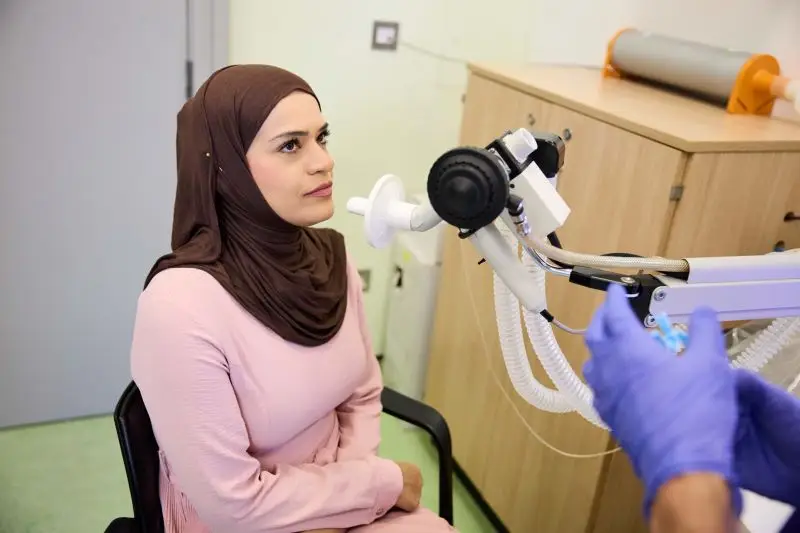
Gas transfer testing assesses how effectively gas passes from the air sacs of the lungs into the bloodstream.
The test is often called the diffusing-capacity test, DLCO or TLCO. You breathe in a very small concentration of test gases, hold your breath briefly and then breathe out into the equipment.
The result provides information about the functioning surface area of the lungs, the pulmonary circulation and gas movement across the alveolar-capillary membrane.
Estimates overall transfer of carbon monoxide from the lungs into the blood.
Expresses transfer in relation to measured alveolar volume.
May help assess emphysema, fibrosis, pulmonary vascular disease and unexplained breathlessness.
Additional tests can assess air remaining inside the lungs after exhalation and identify evidence of eosinophilic airway inflammation.
Spirometry cannot measure all of the air remaining inside the lungs. Lung-volume testing provides measurements such as total lung capacity and residual volume.
Measurements may be obtained using body plethysmography or a gas dilution technique. They can confirm restriction and identify air trapping or hyperinflation.
Fractional exhaled nitric oxide testing measures nitric oxide in a controlled exhaled breath. A raised result may support type 2 or eosinophilic airway inflammation.
Smoking, food, exercise, allergy exposure and corticosteroid treatment can influence the result. Instructions from the testing laboratory take priority.
Read the full FeNO guidePeak expiratory flow measures the maximum speed at which air can be blown out after taking a full breath in.
A small handheld meter can be used at home, often in the morning and evening, over several days or weeks. The pattern of results is more informative than a single measurement.
Cardiopulmonary exercise testing, or CPET, assesses how the lungs, heart, circulation and muscles respond to progressively increasing exercise.
You will usually exercise on a stationary bicycle while wearing a mask or mouthpiece. Breathing, oxygen uptake, carbon-dioxide production, heart rhythm, blood pressure and oxygen saturation are monitored.
The workload increases gradually while the clinical team assesses symptoms and physiological responses.
Helps distinguish respiratory, cardiovascular, muscular, deconditioning and breathing-pattern limitations.
Measures the integrated response to exercise rather than assessing the lungs at rest alone.
May contribute to risk assessment before selected major surgical procedures.
Can guide further investigation, rehabilitation and exercise recommendations.
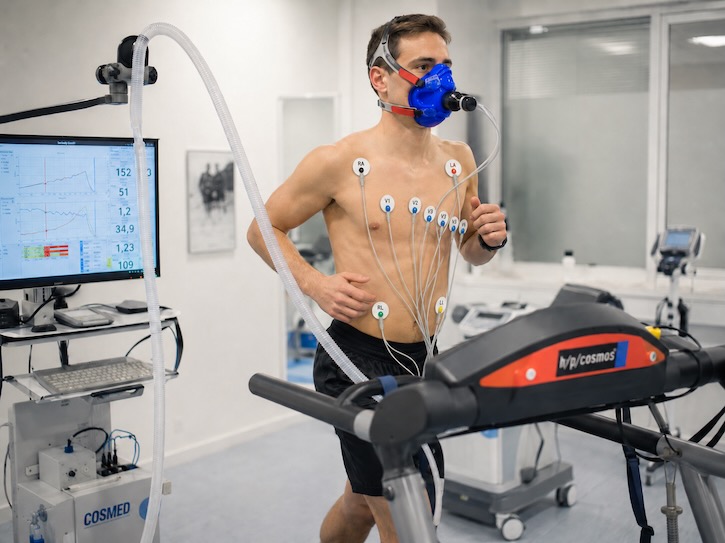
CPET can identify exercise-related abnormalities that may not be apparent during resting lung function or cardiac investigations.
A hypoxic challenge test can help assess whether a person with respiratory disease is likely to require supplemental oxygen during commercial air travel.
Commercial aircraft cabins are pressurised, but the available oxygen pressure is lower than at sea level. During a hypoxic challenge test, the patient breathes a controlled low-oxygen gas mixture designed to simulate typical aircraft-cabin conditions.
Oxygen saturation, symptoms and sometimes arterial or capillary blood gases are monitored. If oxygen falls below the accepted clinical range, the test may be repeated with supplemental oxygen to identify an appropriate in-flight oxygen flow rate.
Resting oxygen levels and clinical history are reviewed.
The patient breathes controlled low-oxygen air while monitored.
Saturation, symptoms and blood gases are assessed as required.
The result helps determine whether in-flight oxygen is needed.
Preparation depends on the tests being performed. Follow the specific instructions provided by the clinic because medication restrictions are not identical for every patient or every investigation.
Some bronchodilators may need to be withheld. Do not stop prescribed treatment unless instructed.
A very large meal may make deep breathing or exercise uncomfortable.
Loose clothing is helpful. CPET normally requires suitable exercise clothing and footwear.
Detailed testing may require several measurements and repeated breathing manoeuvres.
These are commonly used washout periods when the aim is to assess baseline airflow or bronchodilator responsiveness. The instructions issued by the testing clinic always take priority.
| Inhaler category | Examples | Typical withholding period |
|---|---|---|
| Short-acting beta-2 agonist | Salbutamol, terbutaline | 4–6 hours |
| Short-acting muscarinic antagonist | Ipratropium | 12 hours |
| Long-acting beta-2 agonist | Formoterol, salmeterol | 24 hours |
| Ultra-long-acting beta-2 agonist | Indacaterol, vilanterol, olodaterol | 36 hours |
| Long-acting muscarinic antagonist | Tiotropium, umeclidinium, glycopyrronium, aclidinium | 36–48 hours |
| Combination inhaler | ICS/LABA, LABA/LAMA or triple inhalers | Follow the interval for the longest-acting bronchodilator component |
| Inhaled corticosteroid alone | Beclometasone, budesonide, fluticasone | Usually continued unless specifically instructed otherwise |
Do not withhold medication when doing so may be unsafe. If you become breathless or wheezy, use your inhaler according to your prescribed plan and tell the testing team what you took and when.
Results are compared with reference values calculated from factors such as age, sex and height, using the reference equation selected by the laboratory.
Interpretation considers the measured value, expected reference range, lower limit of normal, test quality and the pattern across several measurements.
Spirometry and gas-transfer testing require acceptable, repeatable breathing manoeuvres.
Results may suggest obstruction, restriction, air trapping or reduced gas transfer.
Findings are compared with symptoms, examination, imaging and other investigations.
Arrange a consultation for investigation of breathlessness, cough, wheeze, reduced exercise tolerance or monitoring of a known respiratory condition.