
Central airway collapse and respiratory infection
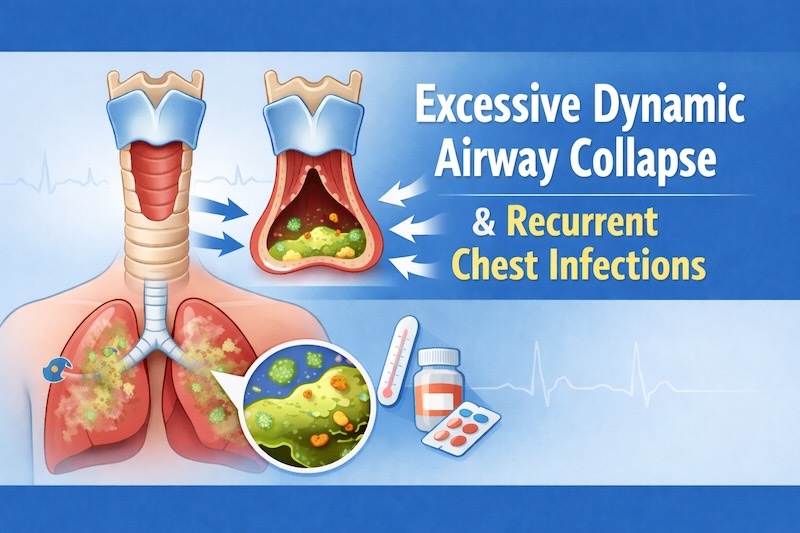
Excessive Dynamic Airway Collapse and Recurrent Chest Infections
Excessive dynamic airway collapse can contribute to persistent cough, difficulty clearing sputum, breathlessness and recurrent respiratory infections. Diagnosis requires more than finding some airway narrowing: the collapse must be interpreted alongside the patient’s symptoms, functional impairment and dynamic airway tests.
- EDAC
- Tracheobronchomalacia
- Dynamic expiratory CT
- Bronchoscopy
- Airway clearance
- CPAP and surgery
Normal spirometry does not exclude EDAC
Routine lung-function testing may be normal or non-specific. Dynamic expiratory imaging or bronchoscopy may be needed when the clinical pattern remains suspicious.
Fifty per cent collapse is not enough by itself
Lesser degrees of expiratory collapse can occur in people without clinically important disease. Diagnosis should incorporate severity, symptoms and functional consequences.
What is excessive dynamic airway collapse?
Excessive dynamic airway collapse, or EDAC, occurs when the posterior membranous wall of the trachea or main bronchi bows excessively into the airway during expiration while the cartilaginous framework remains relatively intact.
The trachea and main bronchi naturally become slightly narrower during breathing out. In EDAC, this movement is exaggerated and can obstruct expiratory airflow, particularly during forced expiration, coughing or exertion.
EDAC belongs to a broader group called expiratory central airway collapse, or ECAC. ECAC includes EDAC, tracheobronchomalacia and mixed patterns.
Older literature frequently used a threshold of at least 50% expiratory reduction in airway calibre. However, this threshold can classify some healthy people as abnormal. Many specialist teams therefore use more stringent grading—often considering at least 70% collapse more suggestive—and relate the measured collapse to symptoms, distribution and functional impairment.
EDAC is a clinical and dynamic-airway diagnosis. A percentage on a scan should not be interpreted in isolation from cough, secretion retention, breathlessness and recurrent infections.
How is EDAC different from tracheobronchomalacia?
Excessive Dynamic Airway Collapse
In EDAC, the posterior membranous wall becomes excessively lax and bows forwards during expiration.
The anterior and lateral cartilaginous airway walls are relatively preserved.
The airway may take on a crescent-shaped appearance as the posterior wall encroaches into the lumen.
Tracheobronchomalacia
In TBM, the cartilaginous support of the trachea, main bronchi or both is weakened.
The anterior or lateral airway walls may collapse during expiration.
Some patients have mixed EDAC and TBM rather than a purely membranous or cartilaginous abnormality.
The distinction helps describe the anatomical mechanism and plan intervention. However, both conditions can produce similar symptoms, and appropriately selected patients may undergo similar stabilisation strategies.
Why the terminology can be confusing
EDAC, TBM and ECAC have sometimes been used interchangeably in clinical records and older publications. Dynamic imaging and bronchoscopy should ideally document the structure involved, the location of collapse and its severity.
Why EDAC can contribute to recurrent chest infections
Effective mucus clearance depends on ciliary movement, adequate airflow and a sufficiently strong huff or cough. Dynamic collapse can interfere with the airflow needed to move secretions through the central airways.
Expiratory airflow becomes restricted
Central airway narrowing reduces the flow available to carry secretions towards the mouth.
Cough becomes less effective
A forceful cough may provoke greater collapse, trapping mucus rather than expelling it.
Secretions remain in the airway
Retained sputum may become thicker and more difficult to mobilise.
Microorganisms can persist
Stagnant mucus can support bacterial growth and recurrent infective exacerbations.
Infection increases inflammation
Repeated infection may further irritate and destabilise the airway.
The cycle repeats
More inflammation, mucus and ineffective cough can lead to further infections.
EDAC may also coexist with bronchiectasis , chronic bacterial infection or impaired swallowing. These conditions can amplify mucus retention and should be assessed rather than assuming that EDAC is the only cause.
Who may be at increased risk of expiratory central airway collapse?
Adult EDAC is often acquired or recognised in the context of other respiratory and systemic conditions. Associations do not necessarily prove that one factor caused the collapse.
EDAC may be suspected when cough or breathlessness appears disproportionate to spirometry, when “wheeze” does not respond as expected to asthma or COPD treatment, or when infections recur despite standard care.
Read more about specialist assessment of persistent or chronic cough and COPD .
Common symptoms of excessive dynamic airway collapse
Some patients report easier breathing when leaning forwards or when positive airway pressure is applied. Symptoms can fluctuate and may be minimal during a routine clinic examination.
EDAC can resemble other respiratory conditions
Cough, wheeze, breathlessness and recurrent infections also occur in asthma, COPD, bronchiectasis, reflux, aspiration, vocal-cord dysfunction and chronic upper-airway disease. A structured assessment is necessary because more than one condition may be present.
How excessive dynamic airway collapse is diagnosed
Diagnosis begins with clinical suspicion and progresses to dynamic assessment of airway behaviour. A standard inspiratory CT or routine spirometry may not demonstrate the abnormality.
- Detailed clinical history Review the character of the cough, infection frequency, sputum, positional symptoms, exertional limitation and response to inhalers or positive pressure.
- Lung-function testing Spirometry assesses airflow obstruction and associated asthma or COPD. A flow-volume loop may suggest large-airway obstruction, but a normal or non-specific result does not exclude EDAC.
- Dynamic expiratory CT CT images obtained during coached forced expiration can show the location, morphology and degree of tracheal or main-bronchial collapse.
- Dynamic flexible bronchoscopy Bronchoscopy allows direct visualisation during breathing, coughing and forced expiration. It remains the reference-standard assessment, particularly when an intervention is being planned.
- Assessment of associated disease CT findings, sputum cultures, reflux symptoms, swallowing, cardiac disease and upper-airway disorders may require separate evaluation.
- Multidisciplinary interpretation The degree of collapse should be matched to symptoms, distribution and the likelihood that stabilising the airway will produce meaningful benefit.
| Investigation | What it can show | Important limitation |
|---|---|---|
| Spirometry and flow-volume loops | Associated obstruction and possible large-airway clues | May be normal or non-specific in clinically important EDAC |
| Standard inspiratory CT | Lung structure, emphysema, bronchiectasis and infection | May not capture expiratory airway collapse |
| Dynamic expiratory CT | Degree, morphology and distribution of expiratory collapse | Results depend on coaching, effort and scanning protocol |
| Dynamic bronchoscopy | Real-time airway movement during breathing and coughing | Invasive and dependent on technique and sedation strategy |
| Four-dimensional CT | Airway movement across multiple phases of respiration | Limited availability and evolving clinical role |
Why the diagnostic threshold remains debated
A reduction of at least 50% has historically been used, but systematic review data show that this threshold identifies a proportion of healthy individuals. Some centres use at least 70% collapse to define abnormality and reserve “severe” disease for near-complete collapse, often above 90%.
No percentage should replace clinical judgement. A patient with substantial collapse but no related symptoms may not require intervention, while a symptomatic patient needs the full pattern reviewed.
Breaking the cycle of airway collapse, mucus retention and infection
Management usually targets several mechanisms at the same time: airway instability, retained secretions, inflammation, infection and contributing conditions.
Stabilise the central airway
Positive pressure can act as a pneumatic splint during expiration in selected patients.
Improve mucus clearance
Physiotherapy and an appropriate device can help move retained secretions.
Treat active infection
Sputum-guided antibiotics may be needed when bacterial infection is present.
Reduce airway inflammation
Associated asthma, COPD or upper-airway disease should be appropriately controlled.
Address reflux and aspiration
Recurrent airway irritation may perpetuate cough and inflammation.
Consider specialist intervention
Severe disease may require an interventional or surgical assessment.
Treatment options for excessive dynamic airway collapse
Optimising associated respiratory conditions
Asthma, COPD, chronic rhinosinusitis, bronchiectasis, obstructive sleep apnoea and infection should be identified and managed. Inhalers treat associated airway disease but do not directly repair the mechanical collapse.
Airway-clearance physiotherapy
A respiratory physiotherapist may use breathing control, modified huffing, active-cycle breathing, autogenic drainage, positioning or an oscillating PEP device.
Forceful coughing is not always helpful because it can increase expiratory collapse. Technique should be adapted to mobilise mucus without repeatedly closing the central airway.
Read more about airway-clearance devices and questions to ask your physiotherapist .
CPAP or bilevel positive airway pressure
Positive airway pressure can act as a pneumatic splint, helping keep the trachea and main bronchi open during expiration.
Some patients use it overnight; others may benefit during exertion or airway-clearance sessions. Evidence is largely based on observational experience and selected case series, so pressures and treatment goals should be individualised.
Airway stent assessment
A temporary silicone or metallic stent may be used by an experienced interventional team to assess whether mechanical airway stabilisation improves cough, breathlessness, exercise capacity or secretion clearance.
Stents can cause mucus plugging, migration, granulation tissue, infection and cough. They are not a simple or risk-free long-term solution.
Surgical tracheobronchoplasty
Tracheobronchoplasty reinforces the posterior airway wall, usually with mesh, to reduce excessive expiratory collapse.
It may improve cough, breathlessness, quality of life and functional capacity in carefully selected patients with severe, symptomatic disease. Surgery is specialised and requires multidisciplinary assessment of anatomy, comorbidity, operative risk and likely benefit.
Living with EDAC: practical measures that may reduce infection risk
Nebulised saline may help selected patients whose secretions remain thick, but it should be assessed for tolerance and used with an effective clearance technique. Read more about nebulised hypertonic saline .
Reflux and aspiration can worsen cough and airway irritation. Read more about the impact of reflux and aspiration on lung disease .
What to expect from a specialist care pathway
Because EDAC overlaps with asthma, COPD and chronic cough, diagnosis may be delayed. A specialist pathway may include:
- Respiratory review Confirm the symptom pattern, infection history, previous imaging and treatment response.
- Dynamic airway investigation Arrange coached dynamic expiratory CT and bronchoscopy where clinically appropriate.
- Physiotherapy assessment Identify a secretion-clearance method that avoids excessive forceful expiration.
- Positive-pressure trial Assess whether airway splinting improves symptoms or clearance.
- Interventional review Consider a stent assessment for selected patients with severe disease and persistent disability.
- Surgical opinion Discuss tracheobronchoplasty only when anatomy, symptoms and anticipated benefit support it.
An intervention should improve a meaningful problem—such as secretion clearance, infection burden, cough, breathlessness or daily function—not merely change the appearance of the airway on a scan.
When urgent medical assessment is needed
Seek urgent help for severe or rapidly worsening symptoms
Contact your clinical team urgently or seek emergency assessment for:
- Severe or rapidly worsening breathlessness
- Blue or grey lips
- Confusion, collapse or reduced consciousness
- Sudden chest pain with breathlessness
- Significant coughing of fresh blood
- High fever with low oxygen levels or severe weakness
- Fainting during a coughing episode
Call 999 for severe breathing difficulty, collapse, heavy bleeding or another immediately life-threatening symptom.
Conclusion
Excessive dynamic airway collapse is a mechanical disorder in which the posterior membranous wall of the trachea or main bronchi bows excessively into the airway during expiration.
The resulting obstruction can weaken expiratory airflow, make coughing less effective and contribute to mucus retention, persistent cough and recurrent chest infections.
EDAC differs anatomically from tracheobronchomalacia, although mixed disease is common and symptoms overlap. Dynamic expiratory CT and bronchoscopy are the principal diagnostic tools.
A finding of 50% collapse alone should not automatically be labelled clinically significant. The severity, symptoms, distribution and functional effect must be assessed together.
Treatment usually begins with management of associated disease, personalised airway clearance and positive airway pressure where helpful. Stents and tracheobronchoplasty are reserved for carefully selected patients with severe symptoms despite conservative care.
Frequently asked questions
Is EDAC the same as tracheobronchomalacia?
No. EDAC principally involves excessive inward bowing of the posterior membranous wall while the cartilage remains relatively intact. TBM involves weakness of the cartilaginous airway wall. Mixed patterns can occur.
Is 50% expiratory collapse enough to diagnose EDAC?
Not by itself. Fifty per cent has been widely used historically, but this degree of collapse can occur in people without clinically important disease. Many centres use higher thresholds and require compatible symptoms and functional impairment.
Can EDAC be missed on routine spirometry or a standard CT?
Yes. Spirometry may be normal or non-specific, and an inspiratory or static CT may not capture expiratory collapse. Dynamic expiratory CT or bronchoscopy may be required.
Will CPAP cure EDAC?
No. CPAP does not repair the underlying structural tendency, but it can act as a pneumatic splint and improve airflow, symptoms or mucus clearance in selected patients.
Why does forceful coughing sometimes make symptoms worse?
Forceful expiration increases pressure around the central airways and may provoke greater collapse. A physiotherapist can teach a modified huffing or clearance technique that moves mucus with less airway compression.
When is surgery considered?
Tracheobronchoplasty may be considered when severe symptoms persist despite optimised medical treatment, physiotherapy and positive-pressure strategies, and when specialist assessment suggests mechanical stabilisation is likely to help.
Why do chest infections keep returning?
Expiratory collapse can reduce cough effectiveness and allow mucus to remain in the airways. Retained mucus can support bacterial growth. Bronchiectasis, aspiration and other causes may also contribute and should be investigated.
Does every patient need a stent trial?
No. Stent assessment is generally reserved for selected patients with severe symptomatic disease when an interventional team needs to estimate the likely benefit of mechanical stabilisation. Stents have important risks.
References and further information
- Pu CY, et al. Expiratory Central Airway Collapse: A Comprehensive Review. Journal of Bronchology and Interventional Pulmonology. 2025. View the review
- Mitropoulos A, et al. Detection and diagnosis of large airway collapse: a systematic review. ERJ Open Research. 2021. View the systematic review
- Aslam A, et al. Tracheobronchomalacia and Excessive Dynamic Airway Collapse: Current Concepts and Future Directions. Radiographics. 2022. View the review
- Zhou P, et al. COPD-Associated Expiratory Central Airway Collapse. Chest. 2025. View the review
- Herrero-Cortina B, et al. European Respiratory Society statement on airway-clearance techniques in adults with bronchiectasis. European Respiratory Journal. 2023. View the statement
- Hill AT, et al. British Thoracic Society guideline for bronchiectasis in adults. Thorax. 2019. View the guideline