
Bronchiectasis treatment evidence
Nebulised Hypertonic Saline: Why One Negative RCT Does Not Mean It Never Helps
The CLEAR trial did not show a significant reduction in bronchiectasis exacerbations across its overall population. That is important—but it does not answer every clinical question about thick, difficult-to-clear mucus.
- CLEAR trial
- Airway clearance
- Thick sputum
- Mucus impaction
- Patient selection
- Safety and tolerance
A negative average is not universal failure
CLEAR did not demonstrate a significant exacerbation benefit across the overall population. It was not designed to prove that no individual patient can experience easier mucus clearance.
It should not be prescribed automatically
The result argues against routine use for every adult with bronchiectasis. Treatment should have a defined goal, appropriate patient selection and review of the individual response.
Nebulised hypertonic saline has had an important setback
In the 2025 CLEAR trial, adding 6% nebulised hypertonic saline to usual care in adults with non-cystic fibrosis bronchiectasis did not significantly reduce pulmonary exacerbations over 52 weeks compared with no hypertonic saline.
Mean pulmonary exacerbations over 52 weeks
Randomised controlled trials are the best method for determining whether a treatment works on average and whether an apparent difference is likely to be reliable rather than due to chance.
The CLEAR result therefore matters. It means that nebulised hypertonic saline should not automatically be added for every adult with bronchiectasis in the expectation that it will reduce annual exacerbations.
However, “this treatment did not significantly improve the primary outcome across the overall trial population” is not identical to “this treatment can never provide a worthwhile benefit to any selected patient”.
A trial can give a robust answer to its prespecified population, comparison and outcome without answering every narrower clinical question about symptoms, mucus properties or individual response.
What nebulised hypertonic saline actually does
Hypertonic saline is a sterile salt solution delivered as a fine mist through a nebuliser. Commonly used concentrations include 3%, 6% and 7%, although the prescribed concentration and volume vary.
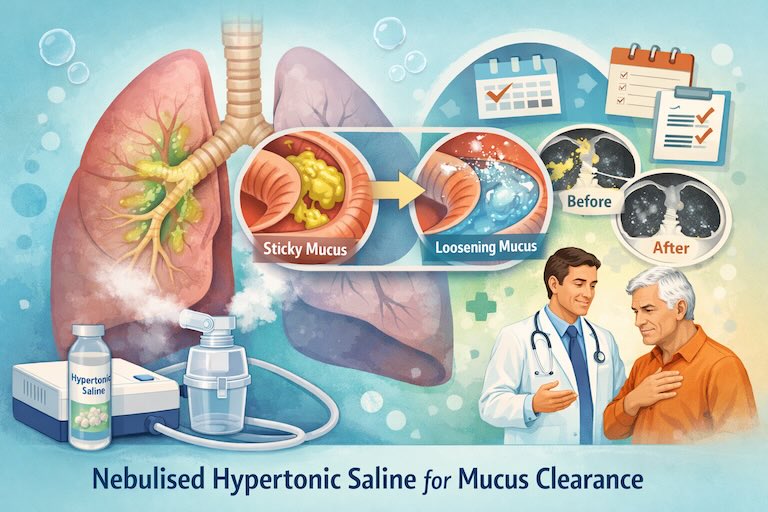
Because the solution contains more salt than normal body fluids, it creates an osmotic effect at the airway surface. In simpler terms, it helps draw water towards the mucus.
Rehydrates airway mucus
Additional water can make dehydrated secretions less dense and less adhesive.
Encourages coughing
The saline mist can stimulate cough, which may help mobilise secretions when combined with an effective technique.
Supports airway clearance
It is normally used before or during physiotherapy rather than as a substitute for airway-clearance exercises.
This is why many clinicians think of hypertonic saline primarily as an airway-clearance aid rather than a conventional flare-up-prevention medicine.
If the day-to-day problem is sputum that is highly viscous, sticky and difficult to mobilise, making the mucus easier to move may still be a clinically relevant aim—even when the treatment has not shown a statistically significant reduction in exacerbation frequency across a broad trial group.
What did earlier studies suggest?
Earlier, generally smaller studies reported outcomes such as increased sputum expectoration, reduced sputum viscosity and, in some studies, improved lung function or quality of life.
The evidence was inconsistent, studies were small and treatment protocols varied. These earlier findings should not override CLEAR, but they help explain why the treatment has remained in specialist practice for selected airway-clearance problems.
What did the CLEAR trial test?
CLEAR was a pragmatic, open-label, randomised, two-by-two factorial trial conducted at 20 hospitals in the United Kingdom.
It enrolled 288 adults with non-cystic fibrosis bronchiectasis, daily sputum production and a history of frequent pulmonary exacerbations. Participants were assigned to receive 6% hypertonic saline, carbocisteine, both treatments or neither treatment.
The primary outcome was the number of pulmonary exacerbations over 52 weeks. This is an important outcome because exacerbations can cause substantial illness, antibiotic exposure, healthcare use and deterioration in quality of life.
Should hypertonic saline be used routinely to reduce exacerbations?
Across the overall trial population, the study did not show a statistically significant reduction in mean pulmonary exacerbations over 52 weeks.
Does it improve airway clearance in a highly selected mucus phenotype?
The study was not designed or powered specifically around patients selected for highly viscous sputum, objectively difficult expectoration or radiological mucus impaction.
The correct interpretation is narrower than “it never works”
CLEAR provides strong evidence against routine use of hypertonic saline as a general exacerbation-reduction strategy for the population studied.
It does not establish that every possible symptom-directed, short-term or phenotype-selected use is ineffective.
The main issue: a different patient may have a different treatment goal
For many people with bronchiectasis, the immediate question is not only, “Will this reduce my annual exacerbation count?”
Their practical question may be:
Will this make the mucus sitting in my chest less sticky and easier to remove during physiotherapy today?
That is a legitimate clinical goal, provided it is assessed honestly. Exacerbation frequency remains important, but it is not identical to sputum viscosity, treatment time, chest congestion, ease of expectoration or mucus impaction on CT.
A treatment could theoretically improve one of those mucus-related outcomes without producing a sufficiently large or consistent reduction in annual exacerbations across a broad trial population.
Why averaging can conceal different responses
Imagine evaluating an intervention designed to relieve severe stiffness in a population containing many people with only mild stiffness. The average effect could appear modest even if a smaller, more severely affected group experiences a meaningful response.
This analogy does not prove that a hypertonic-saline responder subgroup exists. It explains why a broad negative result does not automatically answer an untested subgroup question.
Other limitations worth understanding
Limitations do not invalidate a trial. They define how confidently its findings can be applied to questions beyond the primary analysis.
Sputum amount was not an entry threshold
Participants produced daily sputum, but entry did not require a defined minimum sputum volume or a specific measure of severe sputum retention.
Difficult expectoration was not required
The population was not specifically selected for patients whose mucus remained extremely difficult to clear despite optimised physiotherapy.
Airway-clearance competency was not measured
Participants received airway-clearance care, but the trial could not fully determine how effectively each individual performed the technique over time.
Nebuliser adherence was challenging
Nebulised treatment requires equipment, preparation, cleaning and time. Lower adherence reduces the treatment exposure available to produce a measurable effect.
It was not powered for responder subgroups
A subgroup analysis requires sufficient numbers and a prespecified statistical plan. CLEAR could not reliably establish benefit in a narrowly defined mucus phenotype.
Context can influence exacerbation rates
Recruitment and follow-up overlapped with the COVID-19 period. The investigators did not believe this materially changed the main findings, but pandemic-related behaviour may have altered respiratory exposure for some participants.
Airway-clearance treatment works as a system
Hypertonic saline loosens or hydrates secretions; the patient must then mobilise and expectorate them using an effective airway-clearance technique.
Using saline without competent physiotherapy is rather like softening compacted soil without completing the mechanical work required to remove it.
Why Dr Ricardo José may still consider it for selected patients
Dr Ricardo José’s approach to bronchiectasis management emphasises individualised airway clearance, sputum characteristics and the clinical consequences of mucus retention.
In that context, it may remain reasonable to consider a supervised therapeutic trial where the principal problem is persistent, tenacious mucus despite properly taught and optimised airway-clearance treatment.
Thick, sticky sputum
Secretions remain highly viscous or difficult to mobilise.
Difficult expectoration
Mucus remains hard to clear despite an appropriate physiotherapy routine.
Mucus impaction
CT imaging demonstrates retained secretions or mucus plugging.
Persistent chest congestion
Retained mucus contributes to daily heaviness, rattling or prolonged treatment sessions.
A measurable treatment goal
The patient and clinician can define what improvement would justify continuing treatment.
Ability to use it consistently
The expected benefit is sufficient to justify the added nebuliser burden.
This is not the same as ignoring CLEAR. It uses the trial to avoid indiscriminate prescribing while recognising that the trial did not close every question about phenotype-directed airway-clearance treatment.
The treatment should not be continued merely because its mechanism sounds plausible. A selected patient should demonstrate a worthwhile, reproducible benefit that exceeds inconvenience, adverse effects and treatment burden.
How this fits with bronchiectasis guidance
Airway-clearance techniques remain the foundation of sputum management in bronchiectasis.
British Thoracic Society guidance advises considering an individual trial of mucoactive treatment in patients who have difficulty expectorating sputum. It also recommends an airway-reactivity challenge when inhaled mucoactive treatment is first administered.
The 2025 European Respiratory Society guideline conditionally suggests offering mucoactive treatment when airway-clearance techniques have failed to control symptoms. The certainty of evidence is very low, which is why careful selection and review are important.
What CLEAR changes
CLEAR strengthens the argument against prescribing hypertonic saline routinely to reduce exacerbations in every adult with bronchiectasis.
It also increases the importance of documenting the indication, treatment goal, adherence, tolerance and individual response when a specialist trial is considered.
What a careful individual treatment trial may involve
Hypertonic saline should generally be introduced within a respiratory treatment plan rather than purchased and started without assessment.
- Optimise airway clearance first Confirm that the technique, frequency, position and device are appropriate and that the patient can perform them effectively.
- Define the problem Clarify whether the target is sputum viscosity, difficulty expectorating, mucus impaction, prolonged treatment time or daily chest congestion.
- Assess airway reactivity The first dose is often supervised because concentrated saline can provoke cough, wheeze, chest tightness or bronchospasm.
- Consider bronchodilator pretreatment Some patients may be advised to use a prescribed bronchodilator before saline, particularly where airway reactivity is a concern.
- Use it with physiotherapy Saline is normally followed by the patient’s airway-clearance routine so that loosened secretions are actually removed.
- Review the result Continue only when there is a meaningful improvement in mucus clearance, symptoms, treatment efficiency or another agreed outcome.
| Possible effect | What to do |
|---|---|
| Cough during nebulisation | Some coughing is expected, but severe or distressing cough should be discussed with the respiratory team |
| Throat irritation or salty taste | Technique, concentration, mouth care or treatment timing may need review |
| Chest tightness or wheeze | Stop and follow the advice provided during the supervised challenge; bronchospasm requires clinical review |
| Shortness of breath | Significant or persistent breathlessness should not be ignored and may indicate intolerance |
| No measurable benefit | Reconsider whether the treatment burden is justified rather than continuing indefinitely |
| Easier, more effective clearance | Confirm that the response is reproducible and incorporate treatment into a sustainable airway-clearance plan |
Nebuliser hygiene matters
Equipment must be cleaned, disinfected, dried and replaced according to the manufacturer’s and respiratory team’s instructions. Poor nebuliser hygiene can introduce contamination into the airways.
What counts as a meaningful individual response?
A personal response should be more specific than simply saying that the treatment “feels helpful”.
Useful outcomes may include:
Easier expectoration
Less effort is needed to mobilise and cough up secretions.
Shorter clearance sessions
The same or better clearance is achieved in less time.
Reduced chest congestion
Daily heaviness, rattling or the sensation of retained mucus improves.
Improved sputum characteristics
Secretions become less viscous or easier to move consistently.
Better activity tolerance
Mucus clearance allows easier breathing or activity afterwards.
Acceptable burden
The benefit is sufficient to justify nebulising, cleaning and maintaining the equipment.
Exacerbation frequency may still be monitored, but an individual mucus-clearance trial should be judged against its stated goal.
Conclusion
The CLEAR trial was negative for its primary comparison, and that finding should change practice. Nebulised hypertonic saline should not be prescribed automatically to every adult with bronchiectasis in the expectation that it will reduce exacerbations.
However, the trial did not specifically recruit patients according to severe sputum viscosity, objectively difficult expectoration or persistent mucus impaction, and it was not powered to establish efficacy in narrowly defined responder subgroups.
This leaves room for a cautious, supervised and outcome-based trial in selected patients whose principal problem is tenacious mucus despite properly optimised airway clearance.
Dr Ricardo José recommends optimising physiotherapy first. Where mucus remains viscous, difficult to clear and impacted on imaging, hypertonic saline may then be considered with a defined goal, airway-reactivity assessment and planned review.
The correct message is neither “the trial does not matter” nor “hypertonic saline never helps”. It is that routine prescribing is unsupported, while carefully selected symptom-directed use remains a clinical question requiring individual assessment and measurable benefit.
Frequently asked questions
Does a negative RCT mean nebulised hypertonic saline does not work?
It means the treatment did not demonstrate a statistically significant benefit for the trial’s primary outcome across the overall population studied. It does not prove that no selected patient can experience easier sputum clearance or another clinically relevant response.
What did the CLEAR trial show?
Over 52 weeks, adding 6% hypertonic saline did not significantly reduce mean pulmonary exacerbations compared with no hypertonic saline in the overall trial population.
Should every person with bronchiectasis try hypertonic saline?
No. CLEAR argues against routine prescribing for all adults with bronchiectasis. A trial is more defensible when there is a specific mucus-clearance problem that remains despite optimised physiotherapy.
Why might a specialist still prescribe it?
Some patients principally struggle with highly viscous sputum, ineffective expectoration and mucus plugging. Hypertonic saline may be considered as an airway-clearance aid when the indication and treatment goal are clearly defined.
Who may be most likely to be considered for a treatment trial?
A specialist may consider it where sputum remains thick and difficult to clear despite properly taught airway clearance, particularly when there is retained mucus or mucus impaction on imaging.
Does hypertonic saline replace airway-clearance exercises?
No. It is usually used to assist airway clearance. The loosened secretions still need to be mobilised and removed with an effective physiotherapy technique.
Are there side effects?
Yes. Possible effects include cough, salty taste, throat irritation, chest tightness, wheeze, bronchospasm and shortness of breath. This is why the first dose is commonly supervised.
Why might a bronchodilator be used first?
A prescribed bronchodilator may reduce the risk of airway narrowing in susceptible patients. Whether it is needed depends on the airway-reactivity assessment and specialist advice.
How should benefit be assessed?
The patient and clinician should agree a measurable goal, such as easier expectoration, shorter clearance sessions, reduced congestion or improved sputum mobilisation. Treatment should be reviewed rather than continued automatically.
References and further information
- Bradley JM, et al. Hypertonic Saline or Carbocisteine in Bronchiectasis. New England Journal of Medicine. 2025. View the CLEAR trial
- Chalmers JD, et al. European Respiratory Society clinical practice guideline for the management of adult bronchiectasis. European Respiratory Journal. 2025. View the guideline
- Hill AT, et al. British Thoracic Society guideline for bronchiectasis in adults. Thorax. 2019. View the BTS guideline
- Royal Free London NHS Foundation Trust. Bronchiectasis: nebulised hypertonic saline for adults. View NHS patient information
- North Tees and Hartlepool NHS Foundation Trust. Nebulised hypertonic saline treatment. View NHS patient information
- McCullough B, et al. Mucoactive agents in bronchiectasis: a systematic review and meta-analysis. European Respiratory Review. 2026. View the review