
Targeted COPD treatment
Biologics for COPD: Who They Help, and What to Expect in 2026
Biologics are targeted immune treatments that can reduce flare-ups in a selected subgroup of people with COPD—particularly those with raised blood eosinophils and continued exacerbations despite optimised inhaled treatment.
- Type 2 inflammation
- Blood eosinophils
- Dupilumab
- Mepolizumab
- NICE eligibility
- Exacerbation prevention
The main goal is fewer flare-ups
Biologics are not primarily intended to reverse fixed airflow obstruction. Their most important expected benefit is a reduction in moderate or severe COPD exacerbations.
They are add-on treatments
Inhalers, smoking cessation, vaccinations, physical activity and pulmonary rehabilitation remain central. A biologic does not replace the foundations of COPD care.
What are biologics for COPD?
Biologics are targeted medicines—usually monoclonal antibodies—that block specific immune signals involved in inflammation. They are given by injection in addition to the patient’s usual COPD treatment.
Conventional COPD treatments such as bronchodilator inhalers act mainly on airway narrowing, while inhaled corticosteroids suppress inflammation more broadly. Biologics are more selective. They are designed to interrupt a particular inflammatory pathway that is active in a defined group of patients.
Depending on the medicine, injections may be given every two or four weeks. Some treatments can be self-administered at home after suitable training, while local pathways may initially provide them through specialist respiratory services.
The treatment target in COPD is primarily the prevention of exacerbations. A moderate exacerbation usually requires treatment such as oral corticosteroids or antibiotics. A severe exacerbation leads to emergency assessment or hospital admission.
A successful biologic may reduce how often COPD destabilises. It does not remove emphysema, restore destroyed lung tissue or cure persistent airflow obstruction.
Why biologics only suit some people with COPD
COPD is not one biologically uniform disease. The diagnosis describes persistent airflow obstruction, but the processes driving symptoms and exacerbations vary substantially between patients.
Emphysema-predominant disease
Destruction of lung tissue and loss of elastic recoil may be the principal structural problem.
Chronic bronchitis
Daily cough and sputum production may reflect mucus-gland and airway inflammation.
Infection-prone disease
Recurrent bacterial infection or coexisting bronchiectasis may dominate the exacerbation pattern.
Eosinophilic inflammation
A type 2 inflammatory pattern may drive repeated exacerbations despite inhaled treatment.
Cardiopulmonary overlap
Heart failure, pulmonary vascular disease or arrhythmia may mimic or amplify COPD deterioration.
Multiple simultaneous traits
Many patients have more than one mechanism contributing to symptoms and flare-ups.
Biologics target a specific inflammatory trait. They are therefore unlikely to help when repeated deterioration is mainly caused by poor inhaler technique, infection, heart failure, aspiration, untreated sleep apnoea or another non-targeted mechanism.
Type 2 inflammation and blood eosinophils in COPD
Type 2 inflammation is well recognised in asthma but is also present in a clinically important subgroup of people with COPD. Signals such as interleukin-4, interleukin-5 and interleukin-13 can contribute to eosinophilic inflammation, mucus production and airway instability.
A commonly used selection threshold
Major dupilumab COPD trials and current NICE pathways use a blood eosinophil count of at least 300 cells per microlitre as an important eligibility marker. The result must still be interpreted in the context of exacerbation history and current treatment.
A blood eosinophil count is a practical biomarker rather than a perfect diagnostic test. Counts can vary over time and may be lowered by oral or inhaled corticosteroids, acute illness and other clinical factors.
A single raised result does not automatically mean that a biologic is appropriate. Specialists assess the pattern across time, the timing of steroid exposure, the exacerbation record and whether other causes of deterioration have been addressed.
Type 2 inflammation does not mean COPD has become asthma
COPD and asthma can overlap, but eosinophilic COPD can occur without a separate asthma diagnosis. Establishing the correct diagnosis remains important because asthma and COPD pathways, licences and treatment goals are not identical.
Which biologics have the strongest evidence in COPD?
Dupilumab
Blocks IL-4 and IL-13 signallingDupilumab has consistent phase 3 evidence in adults with COPD, raised eosinophils and continued exacerbations despite optimised inhaled treatment.
The replicate BOREAS and NOTUS trials showed fewer moderate or severe exacerbations and modest improvements in lung function compared with placebo.
It is now an NHS treatment option for eligible adults under NICE technology appraisal guidance.
Mepolizumab
Targets interleukin-5Mepolizumab reduces eosinophilic inflammation by blocking IL-5.
In the 2025 MATINEE phase 3 trial, the annualised rate of moderate or severe exacerbations was 0.80 with mepolizumab and 1.01 with placebo when added to triple inhaled therapy.
NICE published UK recommendations for eligible adults with uncontrolled eosinophilic COPD in June 2026.
Tezepelumab
Blocks thymic stromal lymphopoietinTezepelumab targets an upstream epithelial signal called TSLP, which can activate several inflammatory pathways.
The COURSE study did not meet its primary endpoint across the overall COPD population, although exploratory results raised questions about whether a biomarker-defined subgroup might respond differently.
It is not a standard long-term COPD biologic pathway in 2026.
Benralizumab
Targets the IL-5 receptorBenralizumab depletes eosinophils by targeting the interleukin-5 receptor.
The large GALATHEA and TERRANOVA trials did not show a significant overall reduction in annualised COPD exacerbations at the primary analysis.
It is therefore not a routine maintenance biologic for COPD, although research into narrower responder groups may continue.
| Biologic | Target | Main COPD finding | Position in 2026 |
|---|---|---|---|
| Dupilumab | IL-4 receptor alpha, affecting IL-4 and IL-13 | Replicate phase 3 reduction in moderate or severe exacerbations in selected eosinophilic COPD | Licensed and NICE-recommended for eligible adults |
| Mepolizumab | IL-5 | MATINEE showed a significant reduction in moderate or severe exacerbations | NICE-recommended for eligible adults |
| Tezepelumab | TSLP | Primary endpoint not met in the overall COURSE population | Investigational for COPD |
| Benralizumab | IL-5 receptor alpha | Large phase 3 programme negative overall | Not a routine COPD maintenance treatment |
What the dupilumab trials mean in practice
Dupilumab was studied in patients whose COPD remained uncontrolled despite guideline-based inhaled therapy. Participants had raised blood eosinophils and a history of exacerbations, and the studies largely focused on people with chronic bronchitis symptoms.
Compared with placebo, dupilumab reduced the annualised rate of moderate or severe exacerbations. It also produced a modest average improvement in forced expiratory volume in one second, or FEV1.
These are group averages. One patient may have a substantial reduction in flare-ups, while another may experience little meaningful change. Treatment must therefore be reviewed against a documented baseline.
What “modest lung-function improvement” means
The improvement in FEV1 seen in trials does not mean that biologics reverse established emphysema or permanently restore normal lung function. The practical benefit may feel more like additional breathing headroom or greater stability rather than a dramatic transformation in daily breathlessness.
What the mepolizumab MATINEE trial showed
MATINEE enrolled 804 patients with COPD, an eosinophilic phenotype and continued exacerbations despite triple inhaled therapy. Participants received mepolizumab 100 mg or placebo by subcutaneous injection every four weeks.
The annualised rate of moderate or severe exacerbations was significantly lower with mepolizumab: 0.80 events per year compared with 1.01 with placebo.
The median time to the first moderate or severe exacerbation was also longer with mepolizumab. Differences in symptom and health-related quality-of-life measures were not statistically significant within the trial’s testing hierarchy.
The benefit is primarily exacerbation prevention
MATINEE supports mepolizumab as an option for reducing exacerbations in selected eosinophilic COPD. It should not be presented as a treatment expected to produce major immediate symptom relief in every patient.
Who might be eligible for a COPD biologic?
Exact eligibility depends on the medicine, licence, NICE guidance and local specialist pathway. The following features make consideration more likely:
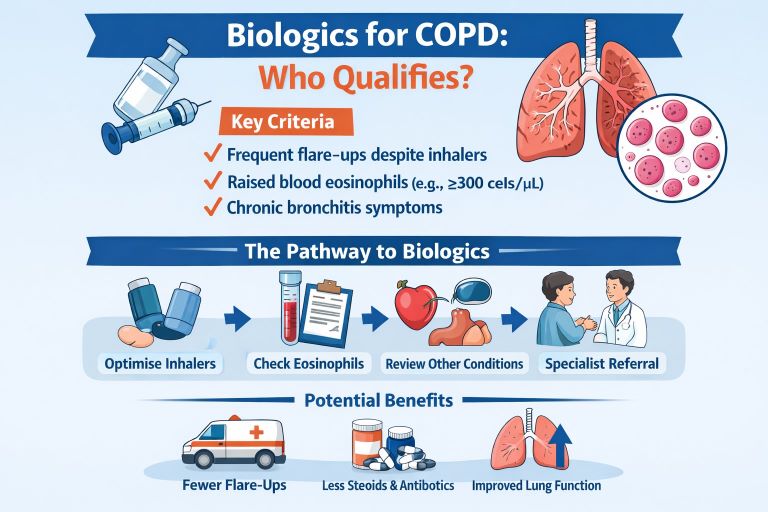
Current NICE pathways define uncontrolled COPD using at least one severe exacerbation or at least two moderate exacerbations in the preceding 12 months, together with raised eosinophils and suitable background treatment.
Chronic breathlessness alone is not enough
A person can be very breathless without having the exacerbation pattern or inflammatory phenotype targeted by biologics. Breathlessness may instead reflect hyperinflation, emphysema, deconditioning, heart disease, obesity, anaemia or dysfunctional breathing.
Exacerbation amplifiers should be addressed first
Before attributing every deterioration to eosinophilic COPD, a respiratory specialist should look for other treatable factors.
Bronchiectasis
Structural airway disease may drive recurrent infection and require airway clearance or microbiology-led treatment.
Reflux or aspiration
Recurrent airway exposure can aggravate cough, wheeze and chest infection risk.
Heart failure
Fluid overload and cardiac breathlessness can be mistaken for COPD exacerbation.
Sleep apnoea
Untreated nocturnal breathing disturbance can worsen symptoms and cardiometabolic risk.
Poor inhaler delivery
Incorrect technique, an unsuitable device or poor adherence may prevent standard treatment from working.
Anxiety and deconditioning
These can increase perceived breathlessness and reduce activity independently of airway inflammation.
Where biologics sit in the GOLD 2026 approach
GOLD 2026 places greater emphasis on personalised escalation for people who continue to exacerbate despite appropriate inhaled therapy.
Dupilumab and mepolizumab now appear as add-on options for selected patients with eosinophilic COPD who remain exacerbation-prone despite optimised treatment.
They sit after the basics of COPD care rather than before them. Diagnosis, inhaler therapy, smoking cessation, vaccination, pulmonary rehabilitation and management of comorbidities still form the treatment foundation.
COPD treatment is moving from a diagnosis-only model towards phenotype-directed care: identify the dominant treatable trait, select the matching intervention and stop treatments that do not produce meaningful benefit.
What is happening in the UK in 2026?
COPD biologics have moved from trial evidence into NHS technology appraisal pathways.
- Dupilumab NICE guidance NICE technology appraisal TA1142 was published on 26 March 2026 for uncontrolled COPD with raised blood eosinophils in adults.
- Mepolizumab NICE guidance NICE technology appraisal TA1166 was published on 17 June 2026 for uncontrolled eosinophilic COPD in adults.
- Specialist assessment Eligibility is expected to be confirmed through a respiratory service with access to spirometry, eosinophil results, exacerbation records and optimisation of inhaled care.
- Documented exacerbations The pathway distinguishes moderate exacerbations treated with oral corticosteroids or antibiotics from severe events requiring hospital care.
- Response review Treatment should be reviewed against the previous exacerbation burden, oral steroid exposure, admissions, tolerability and other agreed outcomes.
- Stopping ineffective treatment Mepolizumab’s NICE appraisal includes a stopping rule at 12 months when COPD has not responded sufficiently.
Access is based on criteria, not simply patient preference
A raised eosinophil count alone does not automatically qualify someone for NHS treatment. Exacerbation frequency, background inhalers, contraindications, diagnostic certainty and previous optimisation must also be considered.
What benefits should you expect—and what should you not expect?
What you may gain
- Fewer moderate or severe COPD exacerbations
- Fewer courses of rescue oral corticosteroids
- Fewer antibiotic-treated flare-ups in some patients
- Reduced urgent-care or hospital use
- Modest improvement in lung function
- Greater stability across the year
What you should not expect
- A cure for COPD
- Reversal of established emphysema
- Immediate relief within a few days
- Normal lung function
- A replacement for inhalers
- A substitute for rehabilitation or smoking cessation
The benefit is assessed over months rather than hours or days. A useful review compares the number and severity of exacerbations before and after treatment while accounting for adherence, seasonal variation and changes in other care.
Safety, side effects and monitoring
Safety profiles differ between medicines. Patients should receive the product-specific information and know how to contact their treatment team.
Injection reactions
Redness, discomfort, itching or swelling can occur where the injection is given.
General adverse effects
Headache, upper respiratory symptoms or other medicine-specific effects may occur.
Allergic reactions
Serious hypersensitivity is uncommon but requires urgent assessment.
The team will monitor exacerbations, hospital admissions, corticosteroid and antibiotic exposure, infections, side effects, adherence and the patient’s overall assessment of benefit.
A biologic should not continue indefinitely simply because it is technically tolerated. If there is no meaningful response, the specialist may recommend stopping it and reassessing other causes of deterioration.
Seek urgent help for signs of a severe allergic reaction
Call 999 for rapidly developing swelling of the face, lips, tongue or throat, severe wheeze, difficulty breathing, collapse or widespread rash accompanied by systemic symptoms.
What may happen at a specialist biologic assessment?
- Confirm the diagnosis Review the clinical history, smoking exposure and post-bronchodilator spirometry.
- Reconstruct the exacerbation history Confirm dates, oral corticosteroids, antibiotics, emergency visits and hospital admissions.
- Review blood eosinophils Examine results across time and consider whether recent corticosteroids may have altered the count.
- Optimise standard care Check inhaler device, technique, adherence, vaccinations, rehabilitation and smoking status.
- Exclude important alternatives Consider asthma, bronchiectasis, infection, reflux, sleep apnoea, heart failure and other contributors.
- Agree measurable goals Document the baseline exacerbation burden and define what would count as a worthwhile response.
Conclusion
Biologics have become a genuine treatment option for a selected group of adults with COPD in 2026.
The strongest current evidence and UK pathways concern dupilumab and mepolizumab for uncontrolled eosinophilic COPD with continued exacerbations despite optimised inhaled treatment.
Blood eosinophils help identify type 2 inflammation, but treatment decisions also depend on confirmed COPD, exacerbation history, background inhalers and exclusion of other causes of deterioration.
The expected benefit is fewer moderate or severe exacerbations and, for some people, modestly better lung function or greater respiratory stability. Biologics do not cure COPD or replace inhalers, rehabilitation, vaccination and smoking cessation.
The best candidate is not simply someone with severe breathlessness. It is someone whose COPD remains exacerbation-prone, whose inflammatory phenotype matches the treatment and whose standard care has already been properly optimised.
Frequently asked questions
Are COPD biologics the same medicines used for asthma?
Some are the same molecules, but the eligible COPD population is narrower and the evidence, licence, dosing pathway and treatment goals must be considered specifically for COPD.
What eosinophil level is high enough?
Current dupilumab and mepolizumab COPD pathways commonly use a threshold of at least 300 cells per microlitre. Eligibility also depends on exacerbations and optimised background treatment.
Will a biologic improve my everyday breathlessness?
It may help some patients, but the primary expected benefit is fewer flare-ups. Day-to-day improvements in breathlessness and lung function are usually modest and variable.
Do I still need my inhalers?
Yes. Biologics are add-on maintenance treatments. Inhalers remain central unless the respiratory specialist makes a separate clinically justified change.
Can I receive a biologic if I have frequent chest infections?
Possibly, but the infection pattern must be assessed. Bronchiectasis, chronic bacterial infection, aspiration and repeated corticosteroid exposure may alter the risk-benefit decision.
How quickly will I know whether it is working?
Benefit is usually assessed over months. The team compares exacerbations, hospital use, rescue treatment and overall stability with the documented period before treatment.
Can a biologic reverse emphysema?
No. Biologics target inflammation and exacerbation risk. They do not regenerate lung tissue destroyed by emphysema.
Are dupilumab and mepolizumab available on the NHS?
NICE issued positive technology appraisal guidance for eligible adults with uncontrolled eosinophilic COPD in 2026. Access remains subject to the published criteria and local specialist implementation.
References and further information
- Global Initiative for Chronic Obstructive Lung Disease. Global Strategy for Prevention, Diagnosis and Management of COPD: 2026 Report. View the GOLD 2026 report
- Bhatt SP, et al. Dupilumab for COPD with Blood Eosinophil Evidence of Type 2 Inflammation. New England Journal of Medicine. 2023. View the BOREAS trial
- Bhatt SP, et al. Dupilumab for COPD with Type 2 Inflammation Indicated by Eosinophil Counts. New England Journal of Medicine. 2024. View the NOTUS trial
- Sciurba FC, et al. Mepolizumab to Prevent Exacerbations of COPD with an Eosinophilic Phenotype. New England Journal of Medicine. 2025. View the MATINEE trial
- Singh D, et al. Efficacy and safety of tezepelumab versus placebo in adults with moderate to very severe COPD: the COURSE trial. Lancet Respiratory Medicine. 2025. View the COURSE trial
- Criner GJ, et al. Benralizumab for the Prevention of COPD Exacerbations. New England Journal of Medicine. 2019. View the GALATHEA and TERRANOVA trials
- National Institute for Health and Care Excellence. Dupilumab for maintenance treatment of uncontrolled COPD with raised blood eosinophils. Technology appraisal TA1142. 2026. View NICE guidance
- National Institute for Health and Care Excellence. Mepolizumab for maintenance treatment of uncontrolled COPD with raised blood eosinophils. Technology appraisal TA1166. 2026. View NICE guidance