
Bronchiectasis prognosis guide
Prognosis of Bronchiectasis: How Accurate Are FACED, BSI and Other Scoring Systems?
Bronchiectasis severity scores can help estimate mortality, hospitalisation and exacerbation risk. They are useful clinical tools, but they describe probability rather than predicting exactly what will happen to an individual patient.
- BSI calculator
- FACED calculator
- E-FACED
- Mortality risk
- Exacerbation risk
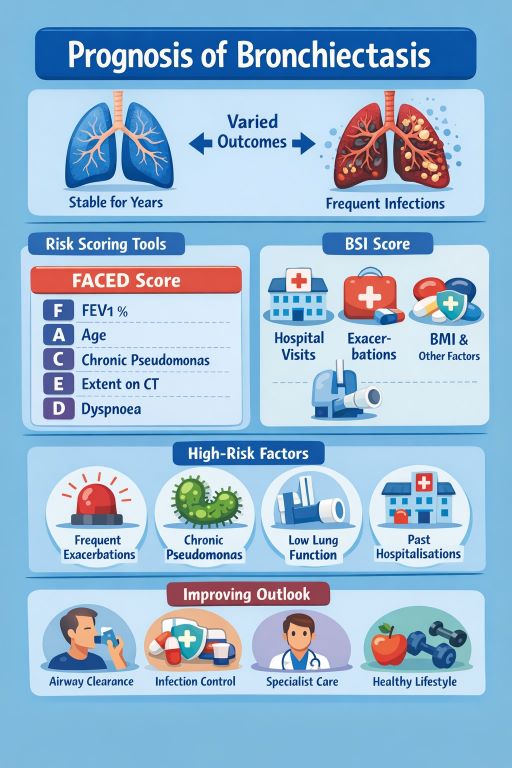
Scores estimate risk
BSI, FACED and E-FACED identify groups with different average risks. They cannot predict an exact survival time or determine with certainty what will happen to one person.
Clinical context remains essential
Symptoms, treatment response, frailty, underlying cause, infection pattern, other illnesses and change over time may not be fully captured by a single score.
Understanding prognosis in bronchiectasis
The prognosis of bronchiectasis has changed significantly over the past two decades. Structured scoring systems now allow clinicians to estimate mortality risk, hospital admissions and future exacerbations with reasonable accuracy.
These tools are based on large patient cohorts and long-term follow-up studies. They identify clinical factors associated with better or worse outcomes and combine them into a numerical score.
However, they estimate risk rather than certainty. They help doctors identify patterns seen across hundreds or thousands of patients and apply those patterns to the individual sitting in clinic.
A score should therefore support clinical judgement, not replace it. A respiratory physician should also consider symptoms, quality of life, infection frequency, sputum microbiology, CT findings, lung function, physical fitness, other medical conditions and response to treatment.
Severity scores estimate the probability of future outcomes. They do not predict an exact life expectancy or guarantee that a particular complication will occur.
Mortality-focused
A concise five-variable score developed primarily to estimate five-year mortality risk.
Adds exacerbations
An extension of FACED that includes recent exacerbation frequency to improve prediction of future flare-ups.
Broader risk assessment
A more detailed score designed to estimate mortality, hospitalisation and future exacerbation risk.
Bronchiectasis severity calculator
Try either the Bronchiectasis Severity Index or FACED calculator below. Some answers require information from spirometry, sputum cultures or the CT report.
A result is only as accurate as the information entered. Do not guess clinical values when records are available.
Bronchiectasis Severity Calculators
Choose either the BSI or FACED score. These tools estimate bronchiectasis severity and may require information from your lung-function test, sputum results and CT scan report.
BMI is calculated from height and weight. A BMI below 18.5 is classified as underweight in this score.
FEV1 is the amount of air blown out in one second. Percentage predicted compares the result with an expected value.
Admission to hospital because of bronchiectasis during the previous two years.
A flare-up involving worsening respiratory symptoms that requires a change in treatment.
The MRC scale grades breathlessness during daily activities from grade 1 to grade 5.
Bacteria repeatedly isolated from sputum samples, including when the patient is clinically stable.
Based on the number of lobes affected or whether cystic bronchiectasis is reported.
Use the percentage-predicted FEV1 from spirometry.
This normally comes from repeated sputum culture results.
The number of lung lobes affected by bronchiectasis.
The modified MRC scale grades breathlessness from 0 to 4.
The FACED score: development and validation
FACED was developed using a large multicentre cohort of people with stable non-cystic fibrosis bronchiectasis. Researchers examined clinical variables and identified five independent predictors that could be combined into a practical mortality score.
| Letter | Variable | What it represents |
|---|---|---|
| F | FEV1 | Degree of airflow limitation on spirometry |
| A | Age | Older age is associated with greater mortality risk |
| C | Chronic Pseudomonas infection | A significant adverse microbiological marker |
| E | Radiological extension | Number of lobes affected on CT imaging |
| D | Dyspnoea | Functional effect of breathlessness |
What the original study found
- Clear separation of mild, moderate and severe groups
- Strong discrimination for five-year mortality
- Five-year survival above 90% in the mild group
- Markedly lower survival in the severe group
- Consistent performance in external cohorts
- A score that was quick to calculate in clinic
Strengths of FACED
FACED is concise and easy to calculate. It is particularly useful as a relatively streamlined estimate of medium-term mortality risk.
Important limitation
FACED was designed around mortality prediction. Later studies found that it was less effective at predicting future exacerbations and hospital admissions.
A patient can therefore have a relatively low FACED score while still experiencing frequent and disruptive flare-ups.
E-FACED: adding exacerbation risk
E-FACED expanded the original score by incorporating exacerbation frequency during the preceding year.
Adding this variable addressed an important limitation of FACED: patients with similar mortality risk may have very different rates of infection, antibiotic use and hospital attendance.
Mortality prediction retained
E-FACED preserved the core mortality-prediction capability of the original FACED model.
Better exacerbation prediction
The additional exacerbation component improved identification of patients likely to experience future flare-ups.
Hospitalisation risk
Validation studies showed improved prediction of admissions compared with the original FACED score.
Still relatively simple
It retains a smaller number of variables than BSI while adding a clinically important recent-outcome measure.
E-FACED may be more useful than FACED when the clinical question concerns both mortality and the likelihood of recurrent exacerbations.
Bronchiectasis Severity Index: a broader approach
The Bronchiectasis Severity Index was developed from an international multicentre cohort and validated across several healthcare systems.
Unlike FACED, the BSI was designed to predict several outcomes, including mortality, hospital admissions and future exacerbations.
It includes:
- Age
- Body mass index
- FEV1 percentage predicted
- Previous hospital admission
- Previous exacerbation frequency
- MRC breathlessness score
- Chronic Pseudomonas infection
- Chronic infection with other organisms
- Radiological severity
What the BSI studies found
Mortality stratification
Mortality risk increased substantially across mild, moderate and severe BSI groups.
Hospital admission prediction
The BSI performed particularly well in identifying patients more likely to require future hospital care.
Exacerbation prediction
Previous flare-ups and hospital admissions make the score more responsive to future healthcare-use risk.
International validation
The score was tested across several cohorts and healthcare systems rather than a single centre.
Why BSI is commonly used
BSI provides a broader view of bronchiectasis severity. It is especially useful when clinicians want to consider mortality, infection burden, hospital admissions and exacerbation risk together.
The trade-off
BSI requires more information than FACED. Some variables can only be entered accurately after reviewing clinical records, recent admissions, sputum cultures and CT findings.
FACED versus E-FACED versus BSI
| Feature | FACED | E-FACED | BSI |
|---|---|---|---|
| Primary focus | Mortality | Mortality and exacerbations | Mortality, hospitalisation and exacerbations |
| Number of core components | Five | FACED plus exacerbations | Nine clinical domains |
| Ease of calculation | Very quick | Quick | More detailed |
| Mortality prediction | Strong | Strong | Strong |
| Exacerbation prediction | Limited | Improved | Generally stronger |
| Hospital admission prediction | Limited | Improved | Generally stronger |
| Best use | Simple mortality-focused assessment | Simplified assessment including recent exacerbations | Comprehensive clinical risk assessment |
Head-to-head studies indicate that both FACED and BSI predict mortality reliably. BSI generally performs better for future exacerbations and hospital admissions because those outcomes and their predictors are built directly into the score.
FACED remains attractive when a rapid mortality-focused estimate is required. E-FACED provides a middle ground by adding exacerbation history without becoming as detailed as BSI.
How accurate are bronchiectasis prognostic scores?
In medical research, predictive performance is often assessed using discrimination, calibration and external validation.
Discrimination
Measures how well a score separates patients who experience an outcome from those who do not.
Typical performance
Many validated bronchiectasis models achieve moderate-to-good, rather than perfect, discriminatory performance.
Individual prediction
A good population-level model still cannot state exactly how long one individual will live.
What is discrimination?
Discrimination describes whether a model generally assigns higher scores to patients who experience the outcome. It does not mean that every individual is classified correctly.
What is calibration?
Calibration examines whether predicted risks match the number of events actually observed. A model may separate higher- and lower-risk groups well but still overestimate or underestimate the absolute risk in a particular population.
Why external validation matters
A score may perform well in the cohort used to create it. Confidence increases when it also performs well in different countries, hospitals, age groups and disease populations.
The scores are useful for separating groups with relatively lower and higher risk. They are much less precise at predicting an exact outcome or survival timeline for a particular individual.
Additional factors associated with prognosis
Registry studies and long-term observational cohorts have repeatedly identified several adverse prognostic factors.
Chronic Pseudomonas infection
Persistent Pseudomonas aeruginosa is associated with more exacerbations, hospital admissions and a less favourable prognosis.
Frequent exacerbations
Repeated flare-ups are associated with greater treatment burden, healthcare use and risk of future exacerbations.
Reduced lung function
Lower FEV1 is consistently associated with increased severity and worse outcomes across scoring systems.
Low body mass index
Being underweight may reflect frailty, nutritional impairment, systemic inflammation or advanced disease.
Previous hospitalisation
Past admission is one of the strongest predictors of future admission and is heavily weighted in the BSI.
Breathlessness and frailty
Functional limitation often reflects the combined effects of lung disease, fitness, cardiovascular health and other conditions.
What about radiological severity?
High-resolution CT is essential for diagnosing bronchiectasis and describing its distribution and morphology.
Greater lobar involvement and cystic bronchiectasis are generally associated with more severe disease. Nevertheless, CT appearances do not always correspond directly with symptom burden.
Radiology cannot be interpreted alone
One patient can have extensive CT abnormalities but relatively stable symptoms, while another with less extensive radiological disease experiences frequent infection and major impairment.
Prognosis therefore requires clinical, physiological, microbiological and radiological information to be considered together.
Why scores should be reassessed
Bronchiectasis prognosis is not fixed permanently at diagnosis. Exacerbation frequency, weight, exercise capacity, infection status, lung function and hospital admissions can change.
Recalculation can be useful after a clinically meaningful change, such as:
- A sustained increase in exacerbations
- A new hospital admission
- Acquisition or eradication of Pseudomonas
- A significant change in FEV1
- Substantial weight loss or nutritional improvement
- Worsening or improving breathlessness
- Introduction of long-term antibiotic treatment
- Improved airway-clearance adherence
Can a score improve?
Yes. Some components, including exacerbation frequency, hospital admissions, BMI and chronic infection status, may improve with effective management.
Age and established structural airway damage cannot be reversed, so a falling score is not the only measure of successful care. Better symptoms and quality of life also matter.
How doctors use prognosis in shared decision-making
Clinicians should not use a severity score to deliver a rigid prediction. Instead, it can support discussion of relative risk, modifiable factors and the intensity of follow-up.
- Explain relative risk clearly
- Identify factors that may be modified
- Prioritise airway-clearance support
- Guide infection-prevention strategies
- Consider long-term antibiotic treatment
- Determine follow-up frequency
- Support referral to specialist services
- Track change over time
A doctor who knows the patient and their disease over time can interpret changes, treatment responses and risks that may not be visible in a one-off numerical score.
Emerging prognostic tools
Research is exploring whether additional biological and digital information can improve prediction beyond current clinical scores.
- Blood inflammatory markers Measures such as C-reactive protein and neutrophil counts may add information about systemic inflammation.
- Sputum microbiome profiling Sequencing may provide a broader view of airway microbial communities than routine culture alone.
- Proteomic and biomarker panels Combinations of proteins or inflammatory markers may identify biological subgroups with different risks.
- Machine-learning models Digital models may combine large numbers of clinical, imaging and laboratory variables.
- Longitudinal data Repeated measurements may predict change more accurately than one assessment performed at a single time point.
Why new tools need validation
A complex model is not automatically better. New approaches must be externally validated, calibrated, clinically interpretable and shown to improve decisions or patient outcomes.
Key points
- Bronchiectasis prognosis can be estimated using validated scores
- FACED was developed mainly to predict mortality
- E-FACED adds recent exacerbation frequency
- BSI assesses mortality, hospitalisation and exacerbation risk
- BSI generally performs better for healthcare-use outcomes
- FACED is quicker and easier to calculate
- Predictive performance is moderate to good, not perfect
- No score predicts an exact life expectancy
- Regular clinical reassessment improves interpretation
- Consistent management can modify important risk factors
Conclusion
FACED, E-FACED and BSI are useful, validated methods of estimating bronchiectasis severity and prognosis.
FACED provides a concise mortality-focused assessment. E-FACED improves consideration of exacerbation risk. BSI provides the broadest assessment and generally performs better when the main concerns are future flare-ups and hospital admissions.
Their accuracy is moderate to good at population level, but none can predict exactly how long an individual will live or what will happen next.
The most reliable interpretation combines the score with symptoms, CT findings, lung function, microbiology, frailty, other medical conditions, treatment response and repeated assessment over time.
Frequently asked questions
Are bronchiectasis prognostic scores reliable?
They are validated tools that reliably identify groups with relatively lower or higher risk. They are less reliable for predicting the exact outcome of one individual.
Which bronchiectasis score is most commonly used?
BSI is widely used for comprehensive assessment. FACED and E-FACED are also used, particularly when a faster or more mortality-focused estimate is required.
Which score is best for predicting exacerbations?
BSI generally predicts exacerbations and hospital admissions better than the original FACED score. E-FACED improves on FACED by adding recent exacerbation frequency.
Can a high score improve over time?
Some components can improve, including weight, exacerbation frequency, hospitalisation history over time and chronic infection status. Other factors, such as age and established airway damage, cannot be reversed.
Do the scores predict exact life expectancy?
No. They estimate the probability of outcomes within groups. They cannot provide an exact survival timeline for an individual patient.
Should every patient have a BSI calculated?
The 2025 ERS guideline recommends calculating BSI in newly diagnosed adults to assess future complication risk. The result should be interpreted clinically rather than used alone.
Does a mild score mean bronchiectasis is unimportant?
No. A person with a mild mortality classification may still have troublesome cough, sputum, fatigue or recurrent exacerbations. Symptom burden and quality of life require separate assessment.
Can I calculate the score without my medical records?
Some components can be answered directly, but accurate FEV1, sputum and CT information normally comes from clinical records. Guessing can produce an incorrect result.
Scientific references
- Chalmers JD, Goeminne P, Aliberti S, et al. The Bronchiectasis Severity Index: An International Derivation and Validation Study. American Journal of Respiratory and Critical Care Medicine. 2014;189(5):576–585. View publication
- Martínez-García MA, de Gracia J, Vendrell Relat M, et al. Multidimensional approach to non-cystic fibrosis bronchiectasis: the FACED score. European Respiratory Journal. 2014;43(5):1357–1367. View publication
- Martínez-García MA, Athanazio RA, Girón R, et al. Predicting high risk of exacerbations in bronchiectasis: the E-FACED score. International Journal of Chronic Obstructive Pulmonary Disease. 2017. View publication
- Ellis HC, Cowman S, Fernandes M, et al. Predicting mortality in bronchiectasis using Bronchiectasis Severity Index and FACED scores: a 15-year follow-up study. European Respiratory Journal. 2016;47(2):482–489. View publication
- Chalmers JD, et al. European Respiratory Society clinical practice guideline for the management of adult bronchiectasis. European Respiratory Journal. 2025. View guideline