
Airway clearance and chest physiotherapy
Airway Clearance Devices: Who Might Benefit and What to Ask Your Physio
Airway-clearance devices can help mobilise sticky mucus when the lungs struggle to remove it naturally. The most effective device is not necessarily the most expensive or sophisticated—it is the one that matches your condition, breathing pattern, cough strength and daily routine.
- Bronchiectasis
- PEP devices
- Oscillating PEP
- HFCWO vests
- CoughAssist
- Cleaning and safety
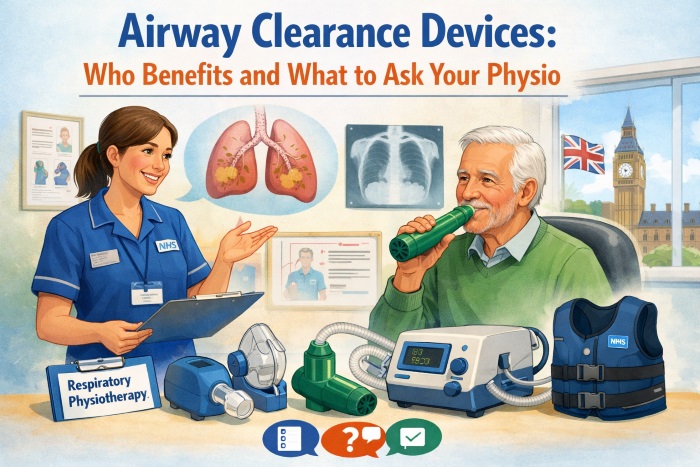
Technique matters more than force
Effective breathing control, huffing and correct resistance usually matter more than forceful coughing or using the highest device setting.
Try before you buy
A device should ideally be assessed and adjusted by a respiratory physiotherapist before you commit to purchasing or using it long term.
What are airway-clearance devices?
Airway clearance is a branch of respiratory physiotherapy that uses breathing techniques, positions, movement and devices to mobilise mucus from smaller airways towards the larger airways, where it can be removed with a huff or cough.
Airway clearance may include techniques such as the Active Cycle of Breathing Technique , autogenic drainage, postural drainage, positive expiratory pressure and oscillating positive expiratory pressure.
Many hand-held devices create resistance while you breathe out. This resistance produces positive expiratory pressure, or PEP, which can help prevent smaller airways from closing too early and may allow air to move behind retained mucus.
Some devices add oscillations or vibrations during exhalation. These pressure changes may help loosen secretions and support their movement towards the central airways.
Keep smaller airways open
Expiratory resistance can reduce premature airway closure during breathing out.
Move air behind mucus
Air may reach less obstructed pathways and help move secretions towards larger airways.
Support huffing and coughing
Once mucus has moved centrally, a controlled huff or cough helps remove it.
An airway-clearance device does not cure bronchiectasis, cystic fibrosis, COPD or neuromuscular weakness. It supports the mechanical removal of mucus produced because of the underlying condition.
Why retained mucus matters
Mucus is part of the lung’s normal defence system. It traps inhaled particles and microorganisms before microscopic cilia move it towards the throat.
Problems arise when mucus becomes unusually thick, is produced in large quantities or cannot be moved because the airways or cough mechanism are impaired.
This mucus–infection–inflammation cycle is particularly important in bronchiectasis .
Who might benefit from an airway-clearance device?
Devices are most likely to be useful when there is a clear secretion-clearance problem. Producing occasional sputum during a cold does not automatically mean that a daily device is needed.
Bronchiectasis
Bronchiectasis often causes daily or recurrent sputum, persistent bacterial infection and repeated exacerbations.
Current guidance recommends teaching an airway-clearance technique and reviewing it after diagnosis, during exacerbations and when symptoms change.
Read more about bronchiectasis diagnosis and treatment .
Cystic fibrosis
Airway clearance is a core part of cystic fibrosis management. PEP, oscillating PEP and other methods may be incorporated into an individual routine alongside inhaled treatments.
COPD with regular sputum
Some people with COPD or chronic bronchitis produce mucus most days or experience repeated infective exacerbations.
A personalised trial may be considered when sputum remains difficult to clear. Not every person with COPD needs a device.
Weak cough from neurological or muscular disease
Motor neurone disease, muscular dystrophy, spinal muscular atrophy, high spinal-cord injury and other conditions can reduce inspiratory strength and peak cough flow.
These patients may need cough-augmentation techniques or mechanical insufflation–exsufflation rather than a standard PEP device.
A device may not be the first or only answer
Some patients clear mucus effectively with ACBT, autogenic drainage, exercise or positioning alone. Others benefit from adding a device. The assessment should identify the simplest effective method that the patient can perform consistently.
Types of airway-clearance device and what they feel like
Positive Expiratory Pressure
PEP mask or mouthpieceA PEP device creates steady resistance as you breathe out. The exhalation should usually be active and controlled rather than forceful.
It may help splint smaller airways open and move air behind secretions.
- Steady, predictable resistance
- Usually compact and portable
- Can be used with breathing-control cycles
- Requires suitable resistance and technique
Oscillating PEP
Flutter, Acapella or Aerobika-style devicesOscillating PEP combines expiratory resistance with repeated pressure oscillations.
Many patients describe a vibrating or fluttering sensation that appears to loosen mucus before huffing or coughing.
- Portable and commonly used at home
- Often paired with huffs and coughs
- Position and flow may affect performance
- Must be cleaned according to device instructions
High-Frequency Chest Wall Oscillation
HFCWO vestAn inflatable vest connects to a machine that delivers rapid pressure pulses around the chest.
Treatment sessions usually need planned pauses for huffs or coughs because loosening mucus does not automatically remove it.
- Hands-free during oscillation
- May help when manual techniques are difficult
- Less portable than a hand-held device
- Usually considered after simpler options
Mechanical Insufflation–Exsufflation
MI-E or CoughAssistMI-E delivers positive pressure to inflate the lungs and then rapidly switches to negative pressure to simulate a stronger expiratory cough flow.
It is primarily used when cough strength is inadequate, especially in neuromuscular or neurological conditions.
- Targets weak cough rather than mucus viscosity
- Settings require specialist adjustment
- May be used more frequently during infection
- Carers may need training
| Device | Main action | May suit | Important limitation |
|---|---|---|---|
| PEP | Steady resistance during exhalation | Patients needing airway splinting and portable treatment | Resistance and breathing pattern must be appropriate |
| Oscillating PEP | Resistance plus oscillation | Patients with sticky sputum who can huff effectively | Performance varies with flow, angle and technique |
| HFCWO vest | External chest-wall oscillation | Selected patients unable to sustain simpler techniques | Cost, size, treatment burden and uncertain superiority |
| MI-E | Assisted inflation followed by rapid exsufflation | Patients with objectively weak or ineffective cough | Requires specialist assessment and personalised pressures |
| IPV | Rapid internal percussive gas pulses | Selected patients in specialist services | Availability and supporting evidence vary |
Other airway-clearance options you may hear about
Intrapulmonary percussive ventilation
IPV delivers small, rapid bursts of gas through a mouthpiece or mask. It may be considered in selected specialist pathways when simpler techniques are ineffective or unsuitable.
Nebulised saline
Isotonic or hypertonic saline may be used before airway clearance to hydrate or loosen secretions in selected patients.
Exercise
Physical activity can increase ventilation and support mucus movement. It may complement—but does not always replace—a personalised airway-clearance routine.
Manual techniques and positioning
Percussion, vibrations, modified postural drainage or caregiver-assisted techniques may be incorporated where appropriate.
How your physiotherapist chooses the right device
A good airway-clearance assessment goes beyond selecting the most popular device. It identifies the physiological problem and whether the proposed technique improves mucus movement without causing excessive fatigue, wheeze, reflux or treatment burden.
Current bronchiectasis guidance does not identify one airway-clearance technique as universally superior. Treatment should be selected according to effectiveness, tolerance, preference and the patient’s ability to use it consistently.
What to ask your physiotherapist before buying or committing
Questions about clinical fit
- Which problem are we targeting: excess mucus, thick mucus, airway collapse, weak cough or repeated infections?
- What suggests that I need a device rather than breathing techniques alone?
- Which options suit my breathing pattern if I wheeze or trap air?
- How will we decide whether this device is helping?
Questions about technique
- Can you watch me use the device and adjust the resistance?
- What should the exhalation feel and sound like?
- When should I huff, cough, pause or repeat the cycle?
- Should I use the device sitting upright or in a drainage position?
Questions about timing
- Should I use a reliever inhaler before airway clearance?
- Where do nebulised saline and antibiotics fit in the routine?
- Should I clear my airways before or after exercise?
- How should the routine change during an exacerbation?
Questions about safety
- When should I stop because of pain, dizziness or breathlessness?
- What should I do if the device makes me wheezy?
- Are there positions or pressures I should avoid?
- What should I do if I cough up blood?
Practical questions
- How do I dismantle, wash, disinfect and dry it?
- How often should valves or mouthpieces be replaced?
- Can I safely travel with it?
- Who should I contact if it breaks or stops oscillating?
How devices fit with inhalers and nebulised treatment
The correct treatment order depends on the diagnosis, medication and individual response. Your respiratory team may recommend a sequence similar to the following, but it should not be assumed to suit everyone.
- Bronchodilator where prescribed A reliever or other bronchodilator may be used first when airway narrowing or saline-related bronchospasm is a concern.
- Mucoactive or nebulised saline treatment Saline may be used to hydrate secretions before the mechanical clearance phase.
- Airway-clearance technique or device Perform the prescribed breathing cycles, PEP or oscillating PEP at the recommended resistance.
- Huff and cough Clear secretions once they have moved into the larger airways.
- Inhaled antibiotic where prescribed Some pathways place nebulised antibiotics after clearance so medication reaches cleaner airways.
- Clean and dry the equipment Do this immediately according to the product instructions and physiotherapy plan.
Do not copy another patient’s sequence
Treatment order differs between conditions and medicines. Nebulised antibiotics, hypertonic saline, inhaled corticosteroids and bronchodilators have different purposes. Confirm your own written plan with the prescribing and physiotherapy teams.
Cleaning and infection control
Airway-clearance devices come into contact with saliva and sputum. Moisture and retained organic material can support microbial growth, so cleaning is part of treatment rather than an optional extra.
Dismantle correctly
Separate only the components identified in the manufacturer’s instructions. Forcing sealed parts may damage valves or oscillating mechanisms.
Wash and rinse
Use the approved cleaning method, rinse away detergent and prevent mucus from drying inside narrow channels.
Air-dry completely
Place parts on a clean surface and allow them to dry fully before reassembly or storage.
Some Acapella-style devices are cleaned after each use by dismantling the approved components, washing them in warm soapy water, rinsing them thoroughly and allowing them to air-dry. However, exact instructions vary by model.
Do not assume that every device can be boiled or steam sterilised
Heat tolerance differs between devices and models. Boiling, dishwashing, steam treatment, alcohol or chemical disinfection may damage an unsuitable device. Follow the product-specific instructions supplied with your equipment.
Getting better results at home without overcomplicating the routine
A sustainable ten- or twenty-minute routine performed correctly may be more useful than a technically impressive device that is rarely used.
How should you judge whether the device is helping?
A treatment trial should have defined outcomes. Clearing more sputum during the first session may be encouraging, but long-term benefit should also consider symptoms, infections and treatment burden.
If a device does not improve mucus clearance, symptoms, treatment efficiency or another agreed outcome, the technique, setting or device choice should be reassessed.
When to stop and seek urgent medical help
Stop treatment and seek urgent advice for significant new symptoms
Contact your clinical team urgently or seek emergency assessment if airway clearance is associated with:
- A significant amount of fresh blood in the sputum
- Sudden sharp chest pain with breathlessness
- Fainting, severe dizziness or collapse
- Severe or rapidly worsening wheeze
- A major fall in oxygen levels
- Rapid deterioration during a respiratory infection
Call 999 for severe breathlessness, blue or grey lips, confusion, collapse or heavy bleeding from the airway.
Conclusion
Airway-clearance devices can help people who regularly retain sputum, experience recurrent chest infections or cannot generate an effective cough.
PEP and oscillating PEP devices support expiratory airflow and mucus mobilisation. HFCWO vests provide external chest-wall oscillation, while mechanical insufflation–exsufflation assists an objectively weak cough.
No single device is best for every patient. Diagnosis, sputum pattern, airway mechanics, cough strength, fatigue, reflux, dexterity, cleaning requirements and lifestyle all influence the choice.
The most useful approach is a supervised trial with a respiratory physiotherapist, clear instructions, a defined treatment goal and review of whether the device produces meaningful benefit.
Frequently asked questions
Can a device replace breathing exercises such as ACBT?
Often not. Many patients use a device within a wider sequence that includes breathing control, thoracic-expansion exercises, huffs and coughs. The device supports mucus mobilisation but does not automatically remove the mucus.
How quickly should I notice a difference?
Some people mobilise additional sputum during the first supervised session. Others notice easier clearance or fewer congestion symptoms over days or weeks. Exacerbation outcomes require longer-term review.
What if the device makes me wheezy or tight-chested?
Stop and rest. Use a prescribed reliever inhaler according to your treatment plan and contact your physiotherapist or respiratory team. The resistance, technique, treatment order or device may need adjustment.
Is CoughAssist only used for motor neurone disease?
No. It is most commonly associated with neuromuscular and neurological weakness, but the central issue is ineffective cough and secretion clearance rather than one diagnostic label.
Is an oscillating device better than ordinary PEP?
Not for every patient. Oscillation may help some people mobilise sticky secretions, while others prefer steady PEP or a breathing-only technique. Current guidance supports personalisation rather than one universally superior device.
Do I need to use the device when I feel well?
This depends on your condition and sputum pattern. Some people need daily maintenance clearance, while others use an intensified plan during exacerbations. Follow the routine agreed with your physiotherapist.
Can I use a device if I have reflux?
Often yes, but meal timing, posture, pressure and drainage positions may need adjustment. Tell your physiotherapist if airway clearance worsens regurgitation, coughing after meals or nocturnal symptoms.
Should I buy a device online before seeing a physiotherapist?
It is better to have an assessment first. A device with the wrong resistance, flow requirement or treatment purpose may be ineffective, uncomfortable or difficult to use safely.
References and further information
- Chalmers JD, et al. European Respiratory Society clinical practice guideline for the management of adult bronchiectasis. European Respiratory Journal. 2025. View the guideline
- Hill AT, et al. British Thoracic Society guideline for bronchiectasis in adults. Thorax. 2019. View the guideline
- British Thoracic Society. Quality Standard for Clinically Significant Bronchiectasis in Adults. 2022. View the quality standard
- National Institute for Health and Care Excellence. Motor neurone disease: assessment and management. NICE guideline NG42. View NICE recommendations