
Targeted and experimental respiratory treatments
Emerging Treatments for Bronchiectasis in 2025
Bronchiectasis treatment is moving beyond a one-size-fits-all approach. Brensocatib has become the first medicine specifically licensed for non-cystic-fibrosis bronchiectasis, while several anti-inflammatory, antibacterial and antifungal treatments remain in clinical development.
- Brensocatib
- Benralizumab
- Ensifentrine
- Murepavadin
- Phage therapy
- Opelconazole
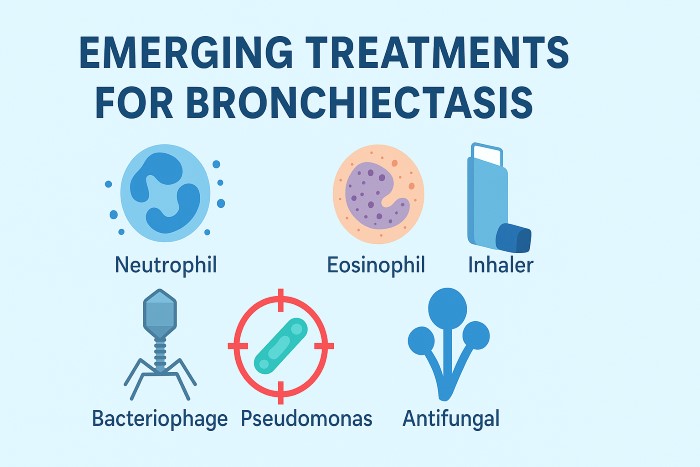
The first targeted medicine has arrived
Brensocatib became the first treatment specifically approved for non-cystic-fibrosis bronchiectasis in the United States in 2025 and was licensed in the UK in February 2026.
Most other options remain experimental
A treatment being studied in a clinical trial is not yet proven, licensed or routinely available. Positive early findings must be confirmed in appropriately designed studies.
Why bronchiectasis treatment is entering a new era
For many years, bronchiectasis treatment concentrated on removing mucus, treating infection and preventing exacerbations. These remain essential, but research is now targeting the distinct inflammatory and microbiological mechanisms that drive disease in different patients.
Bronchiectasis is not one biologically uniform condition. One patient may have predominantly neutrophilic inflammation, another may have an eosinophilic pattern, and another may be limited mainly by chronic Pseudomonas aeruginosa infection or Aspergillus-related disease.
The emerging treatment model is therefore based on phenotyping: identifying the dominant treatable trait and matching it to the most appropriate intervention.
Licensed treatment
Brensocatib now has regulatory authorisation in the United States, European Union and United Kingdom for selected patients.
Late-stage clinical research
Benralizumab is being tested in a phase 3 programme for eosinophilic bronchiectasis.
Earlier investigational strategies
Ensifentrine, precision antibiotics, bacteriophages and inhaled antifungals require further bronchiectasis-specific evidence.
An MHRA licence confirms that a medicine can legally be supplied for its approved indication. Routine NHS access generally also depends on NICE appraisal, commissioning and local implementation.
Brensocatib: the first DPP1 inhibitor for bronchiectasis
Brensocatib — Brinsupri
UK licensedHow it works
Brensocatib blocks dipeptidyl peptidase 1, or DPP1. DPP1 activates neutrophil serine proteases while neutrophils are developing in the bone marrow. Reducing this activation aims to limit excessive protease-driven airway inflammation and tissue injury.
What the evidence showed
In the phase 3 ASPEN trial, both studied doses reduced the annualised rate of pulmonary exacerbations compared with placebo. The 25 mg dose also showed a statistically significant reduction in the rate of lung-function decline over the trial period.
Who may be considered
The UK licence covers patients aged 12 years and over with non-cystic-fibrosis bronchiectasis who experienced at least two exacerbations during the preceding 12 months. NHS availability remains dependent on NICE and local pathways.
Brensocatib is taken as a tablet once daily. The UK and European recommended dose is 25 mg. The United States authorised both 10 mg and 25 mg strengths.
The medicine is intended to reduce exacerbations. It does not reverse established structural airway widening, eradicate chronic infection or replace airway-clearance treatment.
Licensing does not mean that every patient should receive it
A specialist must consider exacerbation frequency, age, comorbidities, immune status, infection pattern, potential adverse effects and the availability of alternative preventive strategies.
Benralizumab: targeting eosinophilic bronchiectasis
Benralizumab
Phase 3 researchHow it works
Benralizumab is a monoclonal antibody that binds to the interleukin-5 receptor on eosinophils. This promotes rapid depletion of eosinophils from the blood and tissues.
Research position
A dedicated phase 3 study is evaluating whether adding benralizumab to standard care reduces exacerbations in adults with non-cystic-fibrosis bronchiectasis and eosinophilic inflammation.
Who might fit the phenotype
Potential candidates may have persistently raised blood eosinophils, eosinophilic airway inflammation, severe asthma or another type 2 inflammatory feature. Trial criteria are more specific than a single raised blood test.
Benralizumab is already used for selected patients with severe eosinophilic asthma, but that does not prove that it treats bronchiectasis itself.
A patient who has both bronchiectasis and severe eosinophilic asthma may receive benralizumab for the asthma indication. Any improvement in bronchiectasis outcomes should be interpreted separately.
A biomarker must match a clinically meaningful pattern
Eosinophil counts can vary and may be altered by oral or inhaled corticosteroids. Diagnosis should consider repeated results, asthma history, exacerbation characteristics and other causes of eosinophilia.
Ensifentrine: bronchodilation and anti-inflammatory activity
Nebulised ensifentrine
Phase 2 bronchiectasis trialHow it works
Ensifentrine inhibits PDE3 and PDE4. PDE3 inhibition produces bronchodilation, while PDE4 inhibition has anti-inflammatory effects. The medicine is delivered directly to the lungs by nebuliser.
Research position
A randomised phase 2 bronchiectasis trial is studying ensifentrine inhalation suspension 3 mg twice daily for at least 24 weeks. Outcomes include safety, symptoms, lung function and exacerbations.
Possible future role
It may eventually suit a subgroup with airflow obstruction, breathlessness, cough or mucus symptoms, but the bronchiectasis trial must establish whether benefits exceed placebo and treatment burden.
Ensifentrine is approved in the United States for maintenance treatment of COPD. That approval should not be extrapolated to bronchiectasis before disease-specific trial results are available.
Inhaled murepavadin: a precision anti-Pseudomonas antibiotic
Inhaled murepavadin
InvestigationalHow it works
Murepavadin targets LptD, a protein required to transport lipopolysaccharide into the outer membrane of Pseudomonas aeruginosa. Disrupting this process weakens the bacterium’s protective outer membrane.
Why inhalation is attractive
Delivering an antibiotic directly to the airway may produce high local concentrations while limiting systemic exposure. It may also improve penetration of infected mucus and bacterial communities.
Current limitation
Murepavadin remains investigational. Its safety, dosing, resistance profile and clinical benefit in bronchiectasis require confirmation before routine use.
Chronic Pseudomonas aeruginosa infection is an important bronchiectasis treatable trait. Current care may include eradication treatment after a new isolation or long-term inhaled antibiotics for selected high-risk patients.
Read more about bronchiectasis diagnosis, sputum microbiology and treatment .
Bacteriophage therapy: viruses designed to attack bacteria
Inhaled bacteriophage therapy
Clinical researchHow it works
Bacteriophages are viruses that infect specific bacteria. Lytic phages enter a susceptible bacterial cell, replicate and cause it to rupture.
Research position
Inhaled phage programmes are studying chronic Pseudomonas aeruginosa airway infection. Phase 2 trials are assessing safety, phage behaviour, bacterial load and clinical outcomes.
Potential future use
Phages may be valuable when organisms are resistant to multiple antibiotics, but bacterial susceptibility, neutralising antibodies, resistance and manufacturing consistency must be addressed.
Some treatments use a standardised mixture active against many bacterial isolates. More personalised approaches match one or more phages to the patient’s cultured organism.
Compassionate access has occasionally been used for severe, otherwise difficult-to-treat infection, but case reports cannot establish routine effectiveness.
Phage therapy should not be presented as a proven replacement for antibiotics
Large controlled bronchiectasis trials are still needed to define the correct product, dose, frequency, duration and patient group. Access should be through a recognised clinical trial or an appropriately governed specialist programme.
Opelconazole: an inhaled antifungal strategy
Opelconazole — formerly PC945
Investigational antifungalHow it works
Opelconazole is an inhaled triazole antifungal. It inhibits fungal ergosterol synthesis, interfering with the construction of the fungal cell membrane.
Why inhalation may help
Local delivery aims to achieve high concentrations in the respiratory tract with lower systemic exposure than an oral azole, potentially reducing drug interactions and body-wide adverse effects.
Current evidence gap
Studies have focused on pulmonary aspergillosis and high-risk transplant populations rather than routine bronchiectasis. Its role in ABPA, colonisation or chronic pulmonary aspergillosis associated with bronchiectasis is not established.
The presence of Aspergillus in a sputum sample does not by itself prove active fungal disease. Allergic bronchopulmonary aspergillosis, fungal sensitisation, colonisation and chronic pulmonary aspergillosis require different diagnostic criteria and treatments.
Specialist diagnosis must come before antifungal treatment
Assessment may include CT appearances, Aspergillus-specific IgE and IgG, total IgE, eosinophils, sputum or bronchoscopy samples, symptoms and immune status.
Emerging bronchiectasis treatments at a glance
| Treatment | Target | Potential patient group | Current position |
|---|---|---|---|
| Brensocatib | DPP1 and neutrophil serine-protease activation | Patients with recurrent exacerbations despite standard care | Licensed in the UK; NICE appraisal paused and NHS access not yet routine |
| Benralizumab | IL-5 receptor and eosinophils | Eosinophilic or type 2 bronchiectasis phenotype | Phase 3 bronchiectasis research |
| Ensifentrine | PDE3 and PDE4 | Possible airflow-obstruction, symptom or inflammatory phenotype | Phase 2 bronchiectasis research |
| Inhaled murepavadin | LptD in Pseudomonas aeruginosa | Chronic or resistant Pseudomonas infection | Investigational |
| Bacteriophage therapy | Susceptible bacterial strains | Difficult-to-treat or multidrug-resistant bacterial infection | Clinical trials and limited specialist access |
| Opelconazole | Fungal ergosterol synthesis | Potential future use in defined Aspergillus-related disease | Investigational; no established routine bronchiectasis role |
Emerging treatments add to—not replace—standard bronchiectasis care
Airway clearance
A respiratory physiotherapist should personalise breathing techniques, huffing, positioning and any airway-clearance device.
Exercise and rehabilitation
Exercise and pulmonary rehabilitation can improve functional capacity, strength, breathlessness and confidence.
Exacerbation treatment
Worsening symptoms should be assessed early, with sputum sampling and antibiotics guided by previous microbiology where possible.
Preventive antibiotics
Macrolides or inhaled antibiotics remain important for appropriately selected patients with continued exacerbation risk.
Vaccination and prevention
Influenza, pneumococcal and other relevant vaccination, smoking cessation and infection-prevention measures remain important.
Associated conditions
Reflux, aspiration, sinus disease, asthma, COPD, immune deficiency and fungal disease require targeted management.
Read more about the 2025 ERS bronchiectasis guidelines and airway-clearance devices .
How specialists match treatment to the individual patient
The future of bronchiectasis care is not one new medicine for everyone. It is the selection of a treatment whose biological target matches the patient’s inflammatory pattern, infection and clinical risk.
What to ask about clinical-trial participation
- What is the treatment designed to target? Ask whether it addresses inflammation, airflow obstruction, bacterial infection, fungal disease or another mechanism.
- Why might I qualify? Clarify the required exacerbation history, organism, biomarker, lung function and previous treatment.
- What phase is the study? Early-phase studies primarily assess safety and dose, while later trials are designed to test clinical effectiveness.
- Could I receive placebo? Understand randomisation, masking and whether standard treatment continues.
- What visits and procedures are required? Trials may involve frequent clinic visits, blood tests, spirometry, sputum sampling, scans or electronic symptom diaries.
- What happens after the study? Ask whether the medicine stops, whether extension access exists and who provides follow-up.
Research participation is voluntary
Declining a clinical trial should not affect access to ordinary clinical care. Participation should follow informed consent and a clear discussion of uncertainty, burden, risks and alternatives.
Conclusion
Bronchiectasis care has entered a significant new phase. Brensocatib is the first medicine specifically licensed to target a central inflammatory mechanism of non-cystic-fibrosis bronchiectasis.
Its phase 3 evidence showed a reduction in exacerbations, and the medicine is now authorised in the United Kingdom for patients aged 12 years and over with at least two exacerbations during the preceding year. Routine NHS access remains dependent on NICE and local implementation.
Benralizumab may define a future treatment pathway for eosinophilic bronchiectasis. Ensifentrine is testing whether combined bronchodilator and anti-inflammatory activity improves bronchiectasis outcomes.
Precision anti-Pseudomonas antibiotics and bacteriophages aim to address difficult bacterial infection, while inhaled antifungals may eventually support carefully defined Aspergillus-related disease.
Most of these treatments remain investigational. Their future role depends on controlled trial results, licensing, safety, cost effectiveness and the ability to identify the patients most likely to benefit.
The foundations of care remain essential: airway clearance, exercise, vaccination, prompt treatment of exacerbations, appropriate long-term antibiotics and management of associated conditions.
Frequently asked questions
Is brensocatib now licensed in the UK?
Yes. The MHRA licensed Brinsupri in February 2026 for patients aged 12 years and over with non-cystic-fibrosis bronchiectasis and at least two exacerbations in the previous 12 months.
Is brensocatib routinely available through the NHS?
Not automatically. NICE’s appraisal is in development but has been paused at the company’s request. NHS availability will depend on a future recommendation and commissioning arrangements.
Does brensocatib cure bronchiectasis?
No. It aims to reduce exacerbations by limiting neutrophil-protease activation. It does not reverse established airway widening or eradicate chronic infection.
Will I still need airway clearance if I take a new medicine?
Usually yes. Emerging medicines target particular disease mechanisms, while airway clearance addresses retained mucus. Treatment should be combined according to individual need.
Can benralizumab treat bronchiectasis now?
Benralizumab is not currently licensed specifically for bronchiectasis. It may be prescribed for a separate severe eosinophilic asthma indication, and its effect in eosinophilic bronchiectasis is being studied.
Is ensifentrine available for bronchiectasis?
No. It is being assessed in a phase 2 bronchiectasis trial. Its US approval for COPD does not establish effectiveness in bronchiectasis.
Can phage therapy treat antibiotic-resistant Pseudomonas?
It is a promising research strategy, but it is not an established routine treatment. Access is generally through a clinical trial or exceptional specialist programme.
Does finding Aspergillus mean I need antifungal treatment?
No. Aspergillus colonisation, sensitisation, ABPA and chronic pulmonary aspergillosis are different conditions. Treatment depends on symptoms, blood tests, microbiology and CT findings.
How can I find out whether I qualify for a trial?
Ask your respiratory specialist to review your diagnosis, exacerbation history, sputum organisms, eosinophils, lung function and previous treatment against current trial criteria.
References and further information
- Chalmers JD, et al. Phase 3 Trial of the DPP-1 Inhibitor Brensocatib in Bronchiectasis. New England Journal of Medicine. 2025. View the ASPEN study
- Medicines and Healthcare products Regulatory Agency. Brensocatib licensed as the first medicine specifically designed to treat non-cystic-fibrosis bronchiectasis. 23 February 2026. View the MHRA announcement
- National Institute for Health and Care Excellence. Brensocatib for treating non-cystic-fibrosis bronchiectasis in people 12 years and over. Technology appraisal in development. View the NICE appraisal page
- US Food and Drug Administration. BRINSUPRI prescribing information. 2025. View the US prescribing information
- European Medicines Agency. Brinsupri product information. View the European product information
- ClinicalTrials.gov. Efficacy and safety of benralizumab in eosinophilic non-cystic-fibrosis bronchiectasis. NCT05006573. View the benralizumab study
- ClinicalTrials.gov. Phase II study of ensifentrine in non-cystic-fibrosis bronchiectasis. NCT06559150. View the ensifentrine study
- ClinicalTrials.gov. Study of inhaled AP-PA02 bacteriophage therapy in chronic Pseudomonas airway infection. NCT05616221. View the phage study
- ClinicalTrials.gov. Opelconazole prophylaxis or pre-emptive treatment against pulmonary aspergillosis in lung-transplant recipients. NCT05037851. View the opelconazole study
- Chalmers JD, et al. European Respiratory Society clinical practice guideline for the management of adult bronchiectasis. European Respiratory Journal. 2025. View the 2025 ERS guideline