
Updated adult bronchiectasis guidance
New 2025 ERS Bronchiectasis Guidelines: What You Need to Know
The 2025 European Respiratory Society bronchiectasis guideline strengthens the role of personalised care, airway clearance, pulmonary rehabilitation and targeted long-term antibiotics. It also moves away from a rigid, one-size-fits-all approach to exacerbation risk.
- Airway clearance
- Macrolides
- Inhaled antibiotics
- Pseudomonas eradication
- Pulmonary rehabilitation
- Personalised care
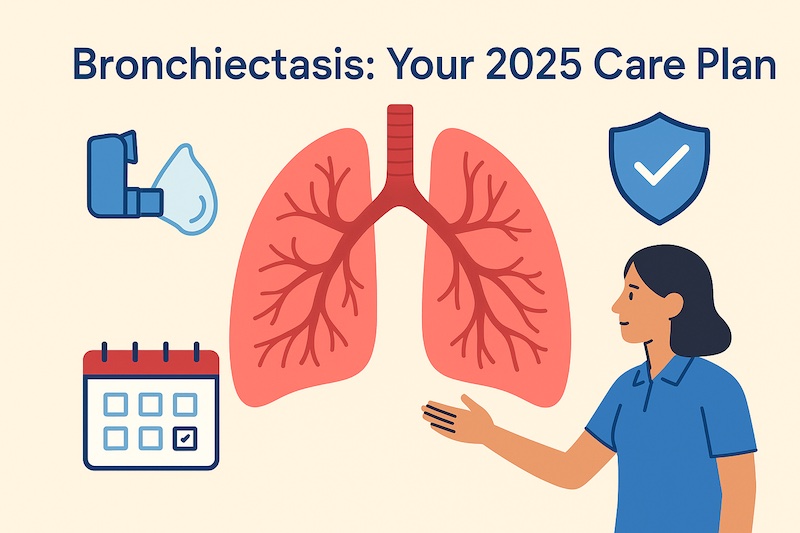
Personalised risk replaces a rigid number
Treatment decisions now consider exacerbations, hospital admissions, daily symptoms, infection patterns, comorbidities and the effect of bronchiectasis on your life.
Treatments should be reviewed
Long-term antibiotics and other preventive treatments should have clear goals and be formally reviewed. Ineffective or poorly tolerated treatment should not simply continue indefinitely.
What is new in the 2025 ERS bronchiectasis guideline?
The new guideline updates the previous 2017 ERS recommendations and places greater emphasis on symptoms, treatable traits, comorbidities, patient priorities and formal evaluation of treatment response.
Personalised care comes first
Your management plan should reflect your symptoms, sputum, infection pattern, exacerbation risk, other medical conditions, treatment burden and personal goals.
Stronger airway-clearance guidance
Airway-clearance techniques now receive a strong recommendation for people with impaired mucus clearance and should be taught by an appropriately trained respiratory physiotherapist.
Broader definition of high risk
Preventive treatment is no longer based only on three or more annual exacerbations. Severe daily symptoms and hospital-level events also influence risk.
Stronger long-term antibiotic recommendations
Long-term macrolides and inhaled antibiotics for chronic Pseudomonas aeruginosa infection have a clearer, stronger role in appropriately selected high-risk patients.
Earlier Pseudomonas action
Eradication treatment should be considered following a new isolation of Pseudomonas aeruginosa, followed by repeat microbiological assessment.
Less routine use of steroid inhalers
Inhaled corticosteroids are not standard bronchiectasis treatment unless another indication—such as asthma or selected COPD—is present.
Pulmonary rehabilitation is prioritised
Rehabilitation receives a strong recommendation for people with impaired exercise capacity and should form part of comprehensive bronchiectasis care.
Comorbidities and treatable traits matter
Reflux, aspiration, sinus disease, asthma, COPD, immune deficiency, anxiety and other contributors should be actively identified and managed.
Earlier reassessment when patients deteriorate
Worsening disease should trigger a structured review of the diagnosis, causes, infection, adherence, airway clearance and advanced treatment options.
What do strong and conditional recommendations mean?
Strong recommendation
The guideline panel believes that most appropriately selected patients should receive the intervention because the expected benefits generally outweigh the risks and burdens.
Conditional recommendation
The intervention may be appropriate, but the decision depends more heavily on individual circumstances, preferences, feasibility, certainty of evidence and treatment burden.
A recommendation does not mean that every patient receives the same treatment. Diagnosis, microbiology, symptoms, safety, preferences and likely benefit still require individual review.
Understanding bronchiectasis in simple terms
In bronchiectasis , parts of the airways become permanently widened and structurally abnormal. Mucus is then more likely to remain in the lungs instead of being cleared normally.
Retained mucus can support bacterial growth, provoke inflammation and contribute to recurrent chest infections. This can create a cycle of mucus retention, infection, inflammation and further airway damage.
Common features include persistent cough, regular sputum, breathlessness, fatigue and exacerbations. However, bronchiectasis varies greatly. Some people have mild intermittent symptoms, while others have daily sputum, chronic infection or frequent hospital admissions.
You can still live well with bronchiectasis
Effective airway clearance, exercise, vaccination, targeted antibiotics and management of underlying causes can substantially reduce symptoms and exacerbations for many people.
Getting the right tests at diagnosis
Bronchiectasis is not simply a CT finding. The assessment should confirm the diagnosis, investigate why it developed, define disease activity and identify treatable traits.
A severity score helps estimate risk and plan follow-up, but it does not replace the patient’s symptoms, microbiology or clinical history. Someone with a lower numerical score may still have severe daily symptoms requiring treatment.
The Bronchiectasis Severity Index can support clinical assessment but should be interpreted by a healthcare professional.
Airway clearance: a central part of bronchiectasis care
The 2025 guideline strongly recommends teaching an airway-clearance technique to people with impaired mucus clearance.
An appropriately experienced respiratory physiotherapist should assess your sputum, breathing pattern, cough, fatigue, reflux, physical ability and daily routine before designing the technique.
Breathing-based techniques
Techniques may include the active cycle of breathing, autogenic drainage, breathing control, thoracic expansion and carefully timed huffs.
The goal is to move mucus with controlled airflow rather than repeated forceful coughing.
Airway-clearance devices
Positive expiratory pressure and oscillating PEP devices may help mobilise secretions when matched to the patient’s airway mechanics and technique.
Read more about airway-clearance devices and what to ask your physiotherapist .
Mucoactive treatment
Nebulised saline or another mucoactive treatment may be considered when sputum remains thick or difficult to clear despite an effective technique.
Treatment should be assessed for bronchospasm, tolerability and measurable benefit.
Exercise and positioning
Physical activity, exercise and suitable drainage positions may complement a formal airway-clearance routine.
Positioning should be adjusted when reflux, joint disease, breathlessness or another problem makes traditional postural drainage unsuitable.
Dornase alfa should not be used routinely
Recombinant human DNase, or dornase alfa, is useful in cystic fibrosis but is not recommended for routine treatment of non-cystic-fibrosis bronchiectasis and may cause harm.
Long-term antibiotics: who may benefit?
Long-term antibiotics are preventive treatments. They are generally considered after standard care—including airway clearance, vaccination and treatment of underlying causes—has been optimised.
The 2025 guideline describes patients as being at high risk when they have:
Long-term macrolides
Long-term macrolides such as azithromycin receive a strong recommendation for appropriately selected patients who remain at high risk of exacerbations despite standard care.
- Nontuberculous mycobacterial infection should be excluded before treatment.
- Heart rhythm, medicine interactions and the QT interval may need assessment.
- Hearing, balance and gastrointestinal adverse effects should be discussed.
- Benefits and adverse effects should be formally reviewed.
Inhaled antibiotics
Long-term inhaled antibiotics receive a strong recommendation for patients with chronic Pseudomonas aeruginosa infection who remain at high risk of exacerbations.
- The medicine is delivered directly to the respiratory tract.
- A suitable nebuliser or inhalation device is required.
- A supervised first dose may be used because bronchospasm can occur.
- Response, adherence and tolerance should be formally reviewed.
| Treatment | Who may be considered | Important checks | Guideline position |
|---|---|---|---|
| Long-term macrolide | Patients at high exacerbation risk despite standard care | NTM, ECG/QT risk, hearing, interactions and adverse effects | Strong recommendation in favour |
| Inhaled antibiotic for chronic Pseudomonas | Chronic P. aeruginosa infection with high exacerbation risk | Bronchospasm, device training, adherence and microbiology | Strong recommendation in favour |
| Inhaled antibiotic for another pathogen | Selected high-risk patients when standard care remains insufficient | Organism, antibiotic choice, tolerance and response | Conditional recommendation |
| Long-term non-macrolide oral antibiotic | Selected situations when preferred options are unsuitable or ineffective | Resistance, adverse effects and limited evidence | Not recommended as routine first-line prevention |
The aim is not simply to suppress every positive sputum culture. Treatment should reduce meaningful outcomes such as exacerbations, admissions, symptoms or treatment burden without creating disproportionate adverse effects or resistance.
First isolation of Pseudomonas: why early action may matter
Pseudomonas aeruginosa can establish chronic infection in structurally abnormal airways. Chronic infection is associated with more exacerbations, hospital admissions and worse outcomes at a population level.
The 2025 guideline conditionally recommends offering eradication treatment following a new isolation of Pseudomonas aeruginosa.
A new isolation can mean the first ever positive culture or a new positive culture after a prolonged period in which the organism was not detected.
- Confirm the result and clinical context Review sputum quality, symptoms, previous cultures, allergies and antibiotic exposure.
- Start the agreed eradication regimen Treatment may involve oral, intravenous or inhaled antibiotics depending on the patient and local pathway.
- Repeat sputum cultures Follow-up testing assesses whether the organism remains present.
- Continue longitudinal surveillance Further sputum monitoring is needed because recurrence or reinfection can occur.
Eradication is not guaranteed
Evidence supporting eradication is less certain than evidence for some other bronchiectasis treatments. The decision should account for likely benefit, antibiotic burden, adverse effects and patient preference.
Inhaled corticosteroids: use only when there is a clear indication
Inhaled corticosteroids do not routinely treat the infection and mucus-clearance mechanisms that define bronchiectasis.
They remain appropriate when a separate condition provides a clear indication, including:
There is emerging interest in blood eosinophils as a possible biomarker in bronchiectasis without asthma. However, the 2025 guideline does not make a routine recommendation for inhaled corticosteroids based on eosinophils alone.
Do not stop a prescribed inhaler without review
Some patients have both bronchiectasis and asthma or COPD. Stopping inhaled corticosteroids without assessing the underlying indication could worsen the coexisting condition.
Pulmonary rehabilitation and everyday physical activity
Pulmonary rehabilitation receives a strong recommendation for people whose exercise capacity is impaired.
Rehabilitation combines supervised exercise, education and self-management support. It may improve:
Everyday activity remains important after the programme ends. Walking, cycling, resistance exercise or chair-based exercise can all be adapted to the individual’s starting point.
Recognising and treating a bronchiectasis exacerbation
An exacerbation is a meaningful deterioration from your usual bronchiectasis symptoms that requires a change in treatment.
- Act early Follow your agreed rescue plan and contact the responsible healthcare service when symptoms deteriorate.
- Send a sputum sample where possible Ideally obtain the sample before antibiotics, provided this does not cause unsafe treatment delay.
- Use previous microbiology Initial antibiotics should reflect previous organisms, sensitivities, allergies and exacerbation severity.
- Increase airway clearance Follow the exacerbation plan provided by your physiotherapist or respiratory team.
- Review the clinical response Reassessment is needed if symptoms worsen or fail to improve as expected.
- Review prevention after recovery Examine why the exacerbation occurred and whether long-term care should change.
How long are antibiotics used?
A 14-day course remains common, particularly for more severe exacerbations or Pseudomonas aeruginosa. Shorter courses may be appropriate in selected milder cases when there is a rapid response. Duration should be individualised by the treating clinician.
Seek urgent medical assessment for red-flag symptoms
- Severe or rapidly worsening breathlessness
- Blue or grey lips
- Confusion, collapse or reduced consciousness
- Severe or persistent chest pain
- A significant amount of fresh blood in the sputum
- Rapidly falling oxygen levels
- High fever with severe weakness or deterioration
Call 999 for severe breathing difficulty, collapse, heavy bleeding or another immediately life-threatening symptom.
Vaccination, lifestyle and associated conditions
Bronchiectasis care extends beyond antibiotics and airway clearance. Small, sustained interventions can reduce exacerbation risk and improve resilience.
Vaccination
Keep seasonal influenza and pneumococcal vaccination up to date. Ask whether COVID-19, RSV or another vaccine is appropriate for your age and risk profile.
Smoking cessation
Smoking increases airway injury and infection risk. Medication and structured stop-smoking support improve the likelihood of success.
Sinus disease
Chronic rhinosinusitis and post-nasal symptoms may increase cough and treatment burden and should be addressed.
Reflux and aspiration
Reflux or swallowing problems may contribute to cough, inflammation and recurrent infection in selected patients.
Nutrition and bone health
Maintaining nutrition, muscle strength, vitamin D and weight-bearing activity supports respiratory and general health.
Mental wellbeing
Anxiety, low mood and treatment burden are common and treatable. They should form part of routine bronchiectasis review.
Read more about the impact of reflux and aspiration on lung disease .
What should happen when bronchiectasis worsens despite treatment?
Continued deterioration should trigger reassessment rather than simply adding repeated antibiotics.
Surgery and transplantation
Surgery may be considered for carefully selected patients with severe, localised bronchiectasis causing recurrent infection or haemoptysis despite optimised treatment.
Patients with advanced, progressive respiratory failure may need timely referral to a transplant centre. Early referral allows proper assessment rather than guaranteeing that transplantation will be required.
Your bronchiectasis clinic checklist
Bring this checklist to your next appointment
- I understand my airway-clearance plan and can demonstrate the technique.
- I know how often to perform airway clearance when stable and during an exacerbation.
- I know when and how to send a sputum sample.
- I have a personalised exacerbation or rescue plan.
- I understand when antibiotics should be started and who to contact.
- We have discussed whether I am at high risk of exacerbations.
- I know whether macrolides or inhaled antibiotics may be appropriate.
- I understand the safety checks needed before long-term antibiotics.
- My influenza, pneumococcal and other relevant vaccinations have been reviewed.
- I have a pulmonary-rehabilitation referral or an agreed physical-activity plan.
- We have reviewed reflux, sinus disease, nutrition, bone health and mental wellbeing.
- I understand which symptoms require urgent assessment.
- I know when my next review will occur and which outcomes are being tracked.
Bottom line for people living with bronchiectasis
The 2025 ERS guideline moves bronchiectasis care further towards a personalised, treatable-traits approach.
Airway clearance is central when mucus clearance is impaired and should be taught and reviewed by a respiratory physiotherapist. Pulmonary rehabilitation has a stronger role when exercise capacity is reduced.
Long-term macrolides and inhaled antibiotics are important exacerbation-prevention options for appropriately selected high-risk patients. New isolation of Pseudomonas aeruginosa should prompt discussion of eradication treatment.
Inhaled corticosteroids should not be used as routine standalone bronchiectasis treatment without another clear indication.
The guideline also emphasises symptoms, comorbidities, treatment burden and formal review. The right treatment is not simply the one recommended on paper—it is the one that is safe, appropriate, practical and produces meaningful benefit for the individual patient.
Frequently asked questions
What is the main message of the 2025 ERS bronchiectasis guideline?
Care should be personalised according to symptoms, mucus clearance, infection pattern, exacerbation risk, comorbidities, treatment burden and patient priorities.
Does everyone with bronchiectasis need daily airway clearance?
The guideline strongly recommends airway-clearance techniques for people with impaired mucus clearance. The frequency and technique should be personalised by a respiratory physiotherapist. Someone with little or no sputum may need a different plan from someone producing sputum every day.
When might long-term macrolides be offered?
They may be offered when a patient remains at high risk of exacerbations despite standard care. This can include at least two annual exacerbations, one severe exacerbation, or one exacerbation together with severe daily symptoms.
What is Pseudomonas and why does it matter?
Pseudomonas aeruginosa is a bacterium that can establish chronic infection in damaged airways. Chronic infection is associated with greater exacerbation risk and may lead to consideration of inhaled antibiotics.
Should a first Pseudomonas result be treated?
The guideline conditionally recommends offering eradication treatment after a new isolation. The decision should consider the clinical context, previous cultures, potential adverse effects and patient preference.
Should I use a steroid inhaler for bronchiectasis?
Not routinely for bronchiectasis alone. An inhaled corticosteroid may still be appropriate when asthma, selected COPD or another recognised indication is present. Do not stop prescribed treatment without a clinical review.
Will pulmonary rehabilitation help?
It can improve exercise capacity, strength, breathlessness and confidence, particularly when bronchiectasis has reduced physical activity or functional capacity.
How can I recognise an exacerbation early?
Look for a clear deterioration from your usual pattern, including more cough, increased or darker sputum, worsening breathlessness, fatigue, fever, chest discomfort or haemoptysis.
How long should exacerbation antibiotics be taken?
Fourteen days remains common, especially for severe exacerbations or Pseudomonas aeruginosa. A shorter course may be appropriate in selected milder cases with rapid improvement. Follow the duration prescribed for your individual episode.
What should I bring to my bronchiectasis appointment?
Bring your medicine list, recent exacerbation dates, antibiotic courses, sputum results, symptoms, airway-clearance questions and the goals that matter most to you.
References and further information
- Chalmers JD, et al. European Respiratory Society clinical practice guideline for the management of adult bronchiectasis. European Respiratory Journal. 2025;66(6):2501126. View the 2025 ERS guideline
- Chalmers JD, et al. The European Respiratory Society guideline for management of bronchiectasis in adults: patient and clinical perspectives. Breathe. 2026. View the guideline overview
- Polverino E, et al. European Respiratory Society guidelines for the management of adult bronchiectasis. European Respiratory Journal. 2017;50:1700629. View the previous 2017 guideline
- Herrero-Cortina B, et al. European Respiratory Society statement on airway-clearance techniques in adults with bronchiectasis. European Respiratory Journal. 2023. View the airway-clearance statement
- Hill AT, et al. British Thoracic Society guideline for bronchiectasis in adults. Thorax. 2019. View the BTS guideline