
Personalised care for overlapping respiratory conditions
Living with Bronchiectasis and Co-Morbidities
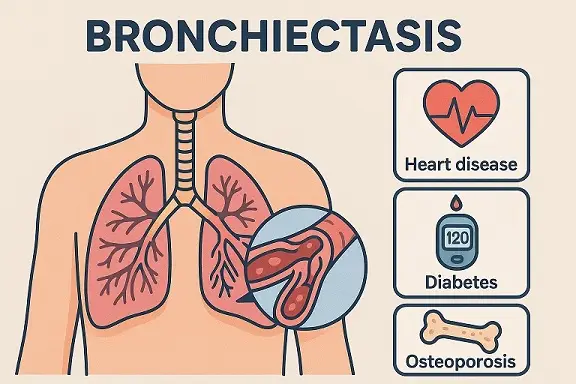
Bronchiectasis frequently coexists with asthma, COPD, reflux, rhinosinusitis, rheumatoid arthritis, ABPA or nontuberculous mycobacterial lung disease. Recognising which condition is driving each symptom helps reduce treatment burden and improves the safety and precision of care.
- Asthma
- COPD
- Reflux
- Rhinosinusitis
- Rheumatoid arthritis
- ABPA
- NTM lung disease
Treatable traits should be identified separately
Cough, wheeze and breathlessness may arise from more than one condition. Treatment should target the mechanism present rather than automatically adding more medication.
Some treatments can conflict
Inhaled steroids, immune suppression, macrolides, antifungals and NTM medicines all require careful indication, interaction checks and microbiological monitoring.
Why co-morbidities matter in bronchiectasis
Bronchiectasis is a chronic condition in which parts of the airways become permanently widened. Abnormal airways retain mucus, increasing the risk of infection, inflammation and repeated exacerbations.
Many patients also live with another respiratory or systemic condition. These co-morbidities may have contributed to the development of bronchiectasis, may worsen its severity, or may create similar symptoms that are difficult to distinguish.
For example, wheeze can reflect asthma, COPD, mucus plugging or an acute infection. Cough may arise from bronchiectasis, reflux, rhinosinusitis, ABPA or several of these at the same time.
Good care therefore requires a whole-patient approach rather than treating every symptom as though it comes from bronchiectasis alone.
Understanding bronchiectasis and its common co-morbidities
Asthma
Asthma causes variable airway narrowing, inflammation and bronchial hyperresponsiveness. It may coexist with bronchiectasis, particularly in patients with eosinophilic inflammation or ABPA.
Typical clues include variable wheeze, night symptoms, reversible airflow obstruction and raised type-2 inflammatory markers.
COPD
COPD produces persistent airflow obstruction and commonly causes cough, sputum and breathlessness. Bronchiectasis may identify a COPD subgroup with more infection and exacerbations.
Smoking history, emphysema, spirometry and exacerbation pattern help clarify the overlap.
Gastro-oesophageal reflux and aspiration
Reflux may provoke cough and throat symptoms. In selected patients, refluxate or swallowed material may enter the airways and contribute to aspiration-related injury or infection.
Heartburn may be absent, so clinical assessment may also consider regurgitation, swallowing difficulty, night cough and recurrent lower-lobe infection.
Chronic rhinosinusitis
Nasal and sinus inflammation can coexist with lower-airway disease as part of a united-airways pattern.
Nasal blockage, discharge, facial pressure, reduced smell and throat clearing can add significantly to cough and sleep disturbance.
Rheumatoid arthritis
Bronchiectasis may occur before or after rheumatoid arthritis. Disease activity, immune-modifying treatment and infection risk must all be considered together.
Other rheumatoid lung manifestations, including interstitial lung disease and pleural disease, may also cause breathlessness.
Allergic bronchopulmonary aspergillosis
ABPA is an immune reaction to Aspergillus, usually in people with asthma or cystic fibrosis but also recognised in bronchiectasis.
It can cause mucus plugging, fluctuating infiltrates, eosinophilia, markedly raised IgE and progressive airway damage.
Nontuberculous mycobacterial lung disease
NTM are environmental organisms that can infect structurally abnormal lungs. A positive culture does not always mean active disease.
Diagnosis requires clinical symptoms, compatible imaging and microbiological criteria, interpreted by an experienced respiratory and microbiology team.
The presence of another diagnosis does not prove that it is responsible for every symptom. Treatment should be based on objective evidence and response rather than labels alone.
The overlap: why diagnosis can be difficult
Bronchiectasis and its co-morbidities share many symptoms. This can delay recognition of a new problem or lead to unnecessary escalation of the wrong treatment.
A careful review may include sputum colour and volume, trigger pattern, spirometry, bronchodilator response, eosinophils, FeNO, reflux or swallowing symptoms, sinus symptoms, CT findings and microbiology.
A change from the patient’s usual pattern is often informative
Purulent sputum and systemic illness may suggest infection. Variable wheeze or night symptoms may suggest asthma. Progressive weight loss, haemoptysis or changing CT nodules may require investigation for NTM or another diagnosis.
Building an accurate, personalised assessment
- Confirm the bronchiectasis diagnosis and distribution Review thin-section CT findings, symptom history and previous imaging.
- Identify the underlying cause Investigate immune deficiency, ABPA, NTM, aspiration and other relevant causes.
- Record co-morbidities objectively Use spirometry, inflammatory markers, microbiology, reflux or swallowing assessment and rheumatological information where appropriate.
- Define current treatable traits These may include retained mucus, airflow obstruction, eosinophilic inflammation, bacterial infection or aspiration.
- Review treatment interactions Consider whether one condition’s medication increases infection, cardiac, liver, hearing or gastrointestinal risk.
- Agree patient-centred goals Prioritise outcomes such as fewer exacerbations, improved sleep, reduced cough, better exercise tolerance or lower treatment burden.
Airway-clearance treatment
Airway-clearance techniques are a central component of bronchiectasis care when mucus clearance is impaired. The method should be taught and reviewed by a respiratory physiotherapist or another appropriately trained professional.
Daily airway-clearance plan
Core bronchiectasis careBreathing techniques
Active-cycle breathing, autogenic drainage, huffing and positioning can help move mucus while reducing exhausting uncontrolled coughing.
Devices
Oscillating positive expiratory pressure devices such as Acapella or Flutter may help selected patients when taught and maintained correctly.
Nebulised treatment
Isotonic or hypertonic saline may improve mucus clearance in selected patients. A supervised challenge may be needed because bronchospasm can occur.
Airway clearance may need adjustment when asthma is unstable, reflux is provoked by positioning, arthritis limits hand function, or fatigue makes a long routine difficult.
Read more about airway-clearance devices and what to ask your physiotherapist .
Managing asthma or COPD alongside bronchiectasis
Bronchodilator treatment
Symptom and airflow assessmentWhen it may help
Short-acting or long-acting bronchodilators may improve breathlessness, wheeze and airflow obstruction in asthma, COPD or selected symptomatic bronchiectasis.
What should be checked
Review inhaler technique, adherence, spirometry, symptom response and adverse effects rather than adding multiple inhalers automatically.
Airway clearance
A bronchodilator may sometimes be used before nebulised saline or airway clearance when bronchospasm is a concern.
Inhaled corticosteroids
Only with a clear indicationAppropriate use
ICS remain important for asthma and selected patients with COPD, particularly when eosinophilic inflammation or exacerbation criteria support their use.
Bronchiectasis alone
ICS should not be prescribed routinely solely because a patient has bronchiectasis, cough or sputum.
Risk review
Use the lowest effective dose and review oral thrush, dysphonia, pneumonia risk and possible mycobacterial or fungal infection.
Do not stop prescribed asthma corticosteroids abruptly
Removing effective anti-inflammatory treatment can cause a severe asthma deterioration. Dose reduction should follow review of the asthma diagnosis, control, inflammatory phenotype and infection risk.
Antibiotic management in complex bronchiectasis
Antibiotic decisions should use previous and current sputum microbiology wherever possible. The presence of asthma, COPD, rheumatoid arthritis, ABPA or NTM may change the balance of benefit, risk and drug interaction.
Treatment of exacerbations
Culture-guided where possibleAssessment
Increasing cough, sputum volume or purulence, breathlessness, wheeze or systemic symptoms may indicate an exacerbation.
Antibiotic choice
Select oral or intravenous treatment using prior culture, allergy, disease severity and clinical response.
Failure to improve
Reassess microbiology, adherence, airway clearance, ABPA, NTM, resistant organisms, aspiration or a non-infective cause.
Long-term preventive antibiotics
High exacerbation riskMacrolides
Long-term azithromycin or erythromycin can reduce exacerbations in selected high-risk patients after standard care has been optimised.
Inhaled antibiotics
Long-term inhaled antibiotics are particularly relevant in chronic Pseudomonas aeruginosa infection with continued exacerbation risk.
Safety checks
Exclude active NTM before macrolide monotherapy and consider ECG, hearing, liver, kidney and interaction risks.
Treating allergic bronchopulmonary aspergillosis
ABPA should be diagnosed using a combination of clinical features, Aspergillus sensitisation, total IgE, eosinophils, Aspergillus IgG and compatible imaging. A positive fungal culture alone does not establish ABPA.
| Treatment | Possible role | Important monitoring |
|---|---|---|
| Oral prednisolone | One first-line option for acute newly diagnosed ABPA or an acute ABPA exacerbation | Infection, glucose, blood pressure, bone health and adrenal suppression |
| Oral itraconazole | Alternative first-line monotherapy in acute ABPA or an option when steroid exposure is undesirable | Liver function, drug level where appropriate, cardiac risk and drug interactions |
| Prednisolone plus itraconazole | More commonly considered for recurrent ABPA exacerbations rather than routine initial treatment | Combined steroid and azole adverse effects and interactions |
| Other azoles | Selected refractory or intolerant cases under specialist care | Drug levels, liver function, photosensitivity, QT effects and interactions |
| Biologic therapy | Selected treatment-dependent or refractory ABPA, particularly with coexisting severe asthma | Phenotype, response, infection risk and commissioning criteria |
High-dose inhaled corticosteroids do not replace systemic ABPA treatment
Inhaled corticosteroids may remain necessary for associated asthma, but they are not considered adequate first-line treatment for an acute ABPA episode.
Response monitoring may include symptoms, imaging and total IgE trends. IgE should be interpreted as a change from the patient’s own baseline rather than expected to return to normal.
Managing nontuberculous mycobacterial lung disease
NTM lung disease is not diagnosed from one isolated sputum culture alone. The organism, number of positive cultures, symptoms and CT pattern must be considered together.
Species-specific multidrug treatment
Specialist managementMAC disease
Macrolide-susceptible MAC treatment commonly includes a macrolide, ethambutol and rifamycin, with frequency and additional agents determined by disease pattern and severity.
Other NTM species
M. kansasii, M. xenopi and M. abscessus require different regimens and susceptibility interpretation.
Duration
Treatment is prolonged and often continues for at least 12 months after culture conversion, depending on species and guideline recommendations.
Aminoglycoside treatment
Selected severe or refractory diseaseIntravenous amikacin
May be included initially in cavitary, advanced, severe-bronchiectatic or macrolide-resistant MAC disease and in selected other NTM infections.
Inhaled liposomal amikacin
Generally considered for refractory MAC disease that remains culture-positive after at least six months of guideline-based therapy.
Monitoring
Hearing, balance, kidney function, vision, liver function, ECG and drug interactions may require monitoring depending on the regimen.
Avoid macrolide monotherapy when active NTM disease is possible
A macrolide given alone for bronchiectasis prevention can select macrolide-resistant NTM. Appropriate mycobacterial cultures should therefore be reviewed before long-term macrolide treatment.
Bronchiectasis and rheumatoid arthritis
The goals are to control joint inflammation, protect mobility and minimise infection risk. Poorly controlled arthritis can make airway clearance, exercise, sleep and self-management more difficult.
Do not stop disease-modifying treatment without specialist advice
Abruptly withholding effective rheumatoid treatment can cause severe disease activity. Changes should be coordinated between the treating teams, particularly during infection.
Addressing reflux, aspiration and chronic rhinosinusitis
Reflux and aspiration
- Avoid lying flat soon after meals.
- Use smaller meals when large meals worsen symptoms.
- Raise the head of the bed for troublesome night reflux.
- Address obesity, alcohol or trigger foods individually.
- Use acid-suppression treatment for an appropriate indication.
- Investigate swallowing difficulty or aspiration symptoms.
Chronic rhinosinusitis
- Use saline nasal irrigation with safe preparation.
- Consider intranasal corticosteroids when indicated.
- Review allergy, nasal polyps and smell disturbance.
- Seek ENT input for persistent or severe disease.
- Consider surgery only after appropriate specialist assessment.
Post-nasal symptoms do not necessarily mean infected secretions are entering the lungs
Upper-airway inflammation can trigger cough and throat clearing, but aspiration is a separate mechanism that may require swallowing or reflux assessment.
Practical tips for managing several conditions
Exercise, pulmonary rehabilitation and fatigue management
Pulmonary rehabilitation is strongly recommended for patients with impaired exercise capacity. It can improve fitness, breathlessness, confidence and health status.
Arthritis, COPD, asthma, deconditioning and fatigue may all limit exercise differently. A personalised programme can combine aerobic exercise, strength work, pacing and education.
Exercise can help mobilise secretions and improve fitness, but patients with substantial sputum retention usually still require a specific airway-clearance plan.
Creating one coordinated care plan
| Area | What should be recorded | Why it matters |
|---|---|---|
| Airway clearance | Technique, frequency, device, nebulised treatment and exacerbation adjustments | Prevents conflicting or duplicated instructions |
| Inhalers | Indication, dose, device, technique and planned review | Reduces unnecessary corticosteroid or bronchodilator burden |
| Microbiology | Routine sputum organisms, Pseudomonas status and NTM results | Guides acute and preventive antibiotic choices |
| Immune-modifying treatment | Steroids, biologics, rheumatology medicines and infection plan | Balances control of inflammation against infection risk |
| ABPA or NTM monitoring | IgE, imaging, cultures, drug levels and toxicity tests | Detects response, relapse and adverse effects |
| Patient goals | Sleep, work, exercise, exacerbations, cough and treatment burden | Keeps treatment focused on outcomes that matter |
When urgent medical assessment is needed
Seek urgent help for significant deterioration
- Severe or rapidly worsening breathlessness
- Blue or grey lips, collapse or confusion
- Significant coughing of fresh blood
- Chest pain with breathlessness or fainting
- Low oxygen levels or a marked fall from usual readings
- Persistent fever, rigors or severe weakness
- New symptoms during intensive immunosuppression
- Severe wheeze not responding to the prescribed rescue plan
Call 999 for severe breathing difficulty, collapse, heavy bleeding or another immediately life-threatening symptom.
Living well despite the complexity
Bronchiectasis commonly coexists with asthma, COPD, reflux, rhinosinusitis, rheumatoid arthritis, ABPA and NTM lung disease. These conditions can overlap in symptoms while requiring very different treatment.
Effective care begins by identifying the active treatable traits: retained mucus, infection, eosinophilic inflammation, airflow obstruction, fungal hypersensitivity, aspiration or systemic inflammatory disease.
Airway clearance remains central when mucus clearance is impaired. Bronchodilators and inhaled corticosteroids should be used for a clear asthma, COPD or airflow-obstruction indication rather than automatically for bronchiectasis.
Long-term macrolides and inhaled antibiotics can reduce exacerbations in appropriately selected patients, but microbiology, NTM status and adverse effects must be reviewed.
Acute ABPA is generally treated with oral prednisolone or oral itraconazole, while NTM disease requires species-specific, prolonged multidrug therapy under specialist supervision.
A coordinated plan, regular review, pulmonary rehabilitation and practical self-management can reduce treatment burden and help many patients maintain an active and fulfilling life.
Frequently asked questions
Can asthma and bronchiectasis occur together?
Yes. The diagnoses can coexist. Asthma treatment should be guided by variable airflow obstruction, symptoms and inflammatory markers, while bronchiectasis care should also address mucus clearance and infection.
Should everyone with bronchiectasis use an inhaled steroid?
No. Inhaled corticosteroids are not routine treatment for bronchiectasis alone. They remain appropriate for asthma and selected COPD or eosinophilic indications.
Can reflux worsen bronchiectasis?
Reflux can aggravate cough and, in selected patients, aspiration may contribute to airway injury or infection. Symptoms should be assessed rather than assuming every cough is reflux-related.
Is post-nasal drip the same as aspiration?
No. Nasal or sinus secretions can cause throat symptoms and cough, while aspiration refers to material entering the lower respiratory tract. Swallowing or reflux assessment may be needed when aspiration is suspected.
Are inhaled corticosteroids the first treatment for ABPA?
No. Acute ABPA is generally treated with oral prednisolone or oral itraconazole. Inhaled corticosteroids may still be used for associated asthma.
Does one positive NTM sputum sample mean I need treatment?
Not necessarily. Diagnosis requires compatible symptoms and imaging together with microbiological criteria. Some patients are monitored rather than treated immediately.
Can I take long-term azithromycin if NTM has been found?
Macrolide monotherapy can select resistant NTM and should not be started without specialist review of mycobacterial cultures and the clinical context.
Can rheumatoid arthritis medicines be continued?
Often they can, but the balance depends on arthritis activity, infection frequency, the medicine used and other lung disease. Changes should be coordinated between rheumatology and respiratory teams.
Does pulmonary rehabilitation help when several conditions are present?
Yes. A personalised programme can improve exercise capacity, breathlessness and confidence while accounting for arthritis, asthma, COPD and deconditioning.
What is the most useful thing to bring to a clinic review?
Bring an up-to-date medication list, inhalers, recent sputum results, a record of exacerbations and a short list of the symptoms or goals that matter most to you.
References and further information
- Chalmers JD, et al. European Respiratory Society clinical practice guideline for the management of adult bronchiectasis. European Respiratory Journal. 2025. View the 2025 ERS guideline
- Hill AT, et al. British Thoracic Society guideline for bronchiectasis in adults. Thorax. 2019;74(Suppl 1):1–69. View the BTS guideline
- Agarwal R, et al. Revised ISHAM-ABPA working group clinical practice guidelines for diagnosing, classifying and treating allergic bronchopulmonary aspergillosis/mycoses. European Respiratory Journal. 2024. View the ABPA guideline
- Daley CL, et al. Treatment of nontuberculous mycobacterial pulmonary disease: an official ATS/ERS/ESCMID/IDSA clinical practice guideline. Clinical Infectious Diseases. 2020;71:905–913. View the NTM guideline
- Herrero-Cortina B, et al. European Respiratory Society statement on airway-clearance techniques in adults with bronchiectasis. European Respiratory Journal. 2023. View the airway-clearance statement